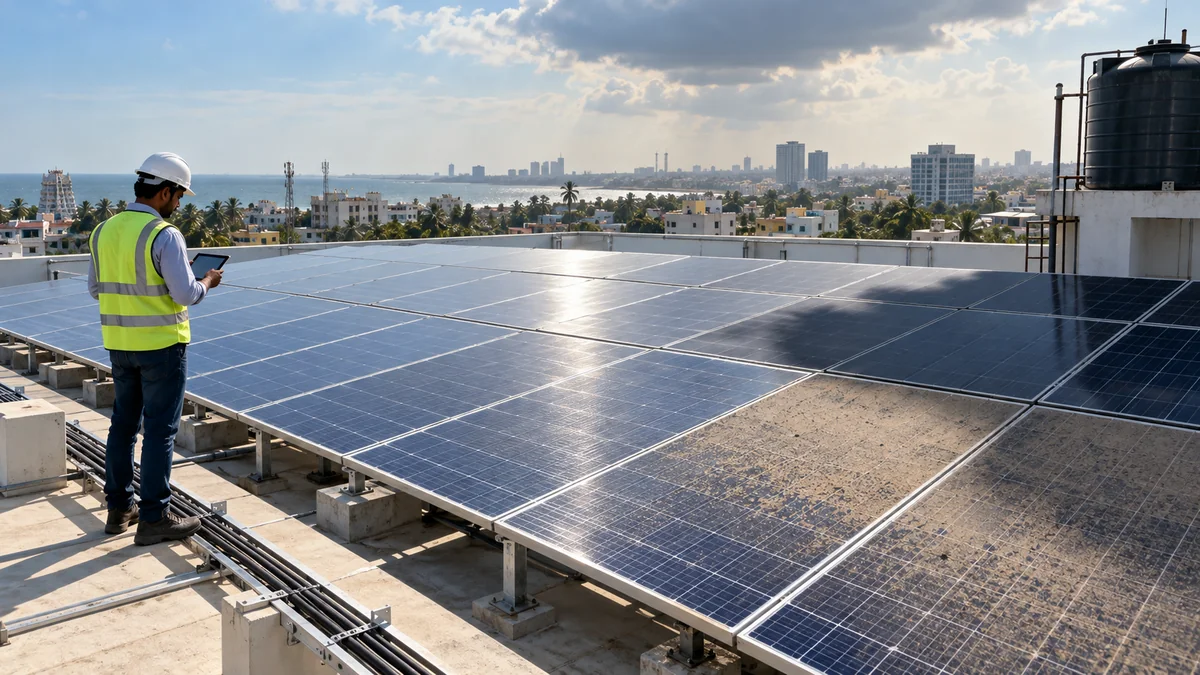
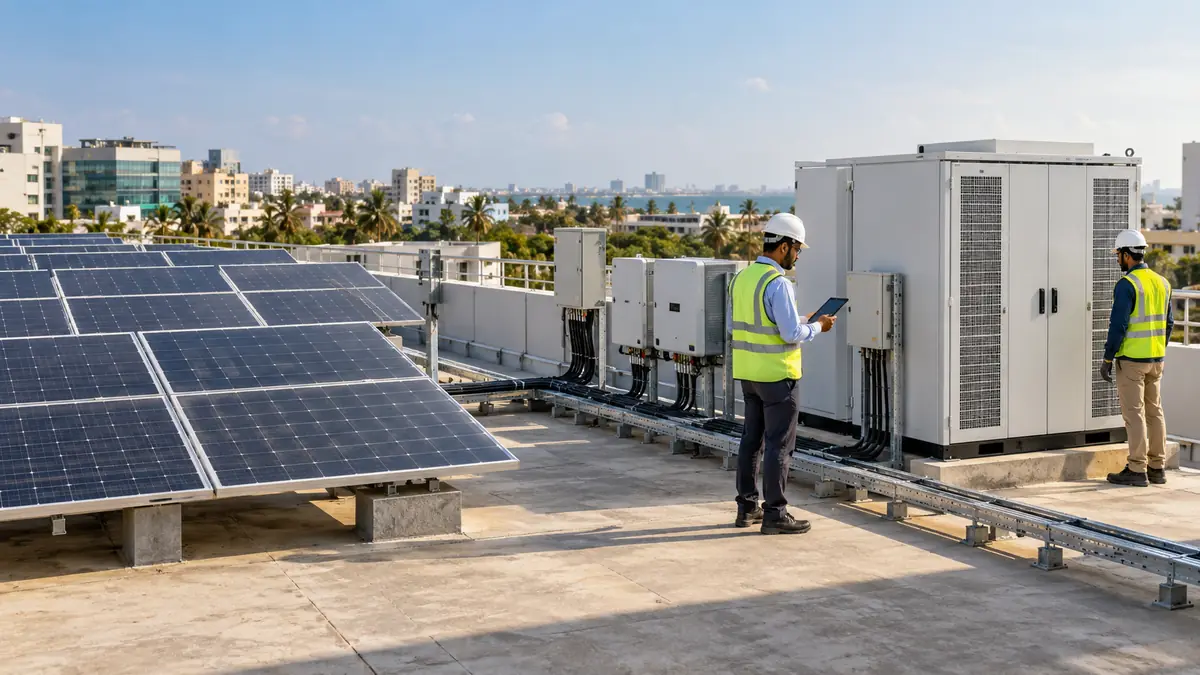
Solar panels generate electricity only when sufficient sunlight is available. A home, apartment complex, office or factory may need power at a different time: after sunset, during a short demand peak or when the grid is unavailable. A battery energy storage system can shift some electricity across time, but it must be designed around a specific purpose.
BESS is often described as a large battery. That description is incomplete. A working storage system also needs power-conversion equipment, battery controls, an energy-management system, protection, thermal management, monitoring and a safe connection to the building and grid.
This guide explains what BESS means, how it works with solar, what its major components do and how Chennai property owners can decide whether storage fits their energy needs.
What Is a Battery Energy Storage System?
A battery energy storage system, or BESS, stores electrical energy in rechargeable batteries and supplies it later according to a defined operating strategy. It can charge from solar, the electricity grid or another permitted source, depending on the system design.
When paired with solar, BESS can store some daytime generation for later use, support selected loads during an outage, reduce short demand peaks or manage the flow of electricity between solar, the building and the grid. It does not create electricity, and it does not automatically make every solar plant operate during a power cut.
In one sentence: solar generates electricity, the BESS stores and releases it, and the control system decides when each action should happen.
What Does BESS Stand For?
BESS stands for Battery Energy Storage System.
The word “system” matters. A complete BESS may contain:
- Battery cells assembled into modules, racks or cabinets
- A battery management system
- A power conversion system or bidirectional inverter
- An energy management system
- Electrical switchgear, protection and isolation
- Meters and sensors
- Cooling or other thermal-management equipment
- Fire detection and safety controls appropriate to the project
- Local and remote monitoring
These elements must work together. Selecting batteries without checking inverter compatibility, protection, control logic, ventilation, fire safety and the building's electrical network can produce a system that is unreliable or unsuitable for the intended job.
How Does BESS Work with Solar?
The exact energy flow depends on the architecture and operating priorities. A common sequence is as follows.
1. Solar Panels Generate Electricity
Solar photovoltaic modules convert sunlight into direct-current electricity. The available output changes with the time of day, cloud cover, temperature, shade, dust and system condition.
2. Solar Power Serves the Active Load
When the building is consuming electricity, the control system can prioritise available solar generation for those active loads. This reduces the amount of electricity imported from the grid at that moment.
3. Surplus Solar Charges the Battery
If solar generation exceeds the permitted immediate use, some of the surplus can charge the battery where the design and control strategy allow it. Electricity is converted into a form that can be stored electrochemically inside the cells.
Charging is not loss-free. Conversion and battery processes consume some energy, so the electricity later delivered by the BESS is lower than the electricity originally sent into it.
4. The Energy Management System Decides When to Discharge
The BESS can release energy after sunset, during a short peak, when the grid is unavailable or when another programmed condition is reached. The energy-management system applies priorities such as:
- Preserve a minimum backup reserve
- Increase the use of solar within the property
- Limit grid import above a defined threshold
- Support identified critical loads
- Avoid charging or discharging outside agreed limits
- Coordinate with the grid, generator or other equipment
The best control strategy depends on the customer's objective. A backup-focused system may hold a higher reserve, while a self-consumption system may cycle more energy each day.
5. The Power Conversion System Supplies Usable Electricity
Battery cells store DC energy. A power conversion system converts energy between DC and AC as required for charging, discharging and connection to the building's electrical network.
6. The Battery Management System Protects the Cells
The battery management system, or BMS, monitors parameters such as cell voltage, current, temperature and state of charge. It keeps operation within permitted limits and can trigger alarms, reduce power or shut the battery down when abnormal conditions are detected.
7. Monitoring Records Performance and Alarms
The owner and service team should be able to review state of charge, charging and discharging power, stored and delivered energy, equipment availability, temperature and alarms. Monitoring helps separate a real equipment problem from a change in load, solar generation or operating schedule.
A Simple Solar-and-BESS Energy Flow
During a normal sunny day, the sequence may look like this:
- Solar serves the building's current load.
- Available surplus charges the BESS, subject to limits.
- Any remaining surplus follows the approved export or control arrangement.
- Later, the BESS discharges according to its programmed objective.
- The grid supplies any remaining demand that solar and storage do not cover.
During a grid outage, the sequence is different. Backup works only if the system has the required isolation, protection, controls and equipment capable of forming or supporting a stable local supply. The backed-up loads must also be separated or managed within the BESS power and energy limits.
A normal on-grid solar inverter generally stops when the grid fails because it must not energise the public network. Read the comparison of on-grid, off-grid and hybrid solar systems before assuming that adding any battery will provide automatic backup.
What Are the Main Components of a BESS?
Battery Cells, Modules and Racks
Cells are the basic electrochemical units. They are assembled into modules and larger packs, racks or cabinets to reach the required voltage, power and energy capacity. Commercial and industrial projects may use multiple cabinets or containerised systems.
Battery chemistry affects operating temperature, power capability, lifecycle, safety behaviour, size, weight, cost and recycling considerations. Chemistry should be evaluated together with the full system design rather than treated as a standalone marketing label.
Battery Management System
The BMS measures and protects the battery at cell, module or rack level. It helps prevent operation outside specified voltage, current and temperature ranges and estimates values such as state of charge and battery health.
Power Conversion System
The PCS controls the flow of power between the battery and the AC electrical system. Its kW rating affects how quickly the BESS can charge or discharge and how much load it can support at one moment.
Energy Management System
The EMS uses meter data, schedules, load conditions, solar availability and operating rules to decide when the BESS should charge, discharge or remain in reserve. The EMS is essential when the project has several objectives or must coordinate solar, grid supply and a generator.
Protection, Isolation and Switchgear
Electrical protection detects faults and disconnects equipment when necessary. Grid isolation is especially important for any system intended to operate during an outage. The arrangement must prevent unintended backfeed and clearly define which circuits remain energised.
Thermal and Fire-Safety Systems
Battery performance and safety depend on temperature control and proper installation conditions. The project may require ventilation or cooling, detection, alarms, emergency shutdown, fire separation and a site-specific response plan. Requirements differ between a small residential unit and a large commercial or industrial installation.
Monitoring and Communication
Monitoring connects the battery, PCS, BMS, meters and EMS. It should give the owner useful visibility without allowing untrained users to change safety-critical settings.
Battery kW and kWh: What Is the Difference?
This is the most important sizing distinction.
kW measures power. It describes how much load the BESS can support or how fast it can charge or discharge at one moment.
kWh measures energy. It describes how much stored electricity is available over time.
A simplified initial calculation is:
Required usable battery energy in kWh = Supported load in kW × Required duration in hours
If selected loads total 10 kW and must run for two hours, the starting usable-energy requirement is 20 kWh. The installed capacity may need to be higher after considering the permitted operating window, conversion losses, temperature, ageing reserve and future demand.
The BESS must also have sufficient power. A battery with adequate kWh but inadequate kW may run for a long time at a lower load yet fail to start or support the intended equipment.
For the solar side of the project, the guide on calculating the right solar-system size explains why capacity should be based on energy use, roof conditions and project objectives rather than a standard package.
What Can Solar Plus BESS Do?
Increase Solar Self-Consumption
A property that generates more solar than it can use at midday may store some energy for later consumption. The benefit depends on how much surplus actually exists, when later demand occurs, export treatment, system losses and battery cycling.
Support Selected Loads During Outages
BESS can supply an intentionally designed backup network. The most economical approach is often to identify critical circuits rather than promise whole-building backup.
Critical loads may include lighting, internet and communication, control systems, selected refrigeration, security, servers or essential process equipment. Each load must be checked for running power, starting power and required duration.
Reduce Short Demand Peaks
At commercial and industrial facilities, BESS may discharge when site demand approaches a defined limit. This is called peak shaving. The business case requires interval-load data and a clear understanding of how relevant electricity charges are calculated.
Coordinate with a Diesel Generator
Where a generator is already installed, solar and BESS may reduce generator runtime or support smoother operating transitions. However, generator minimum loading, reverse-power risk, voltage and frequency control, starting currents and the switching sequence must be engineered and tested.
Manage Export or Solar Curtailment
A control system can charge the battery or reduce solar output when export is constrained. Storage does not remove every limit. Once the battery is full or reaches its charge-power limit, the system still needs an approved response.
What BESS Cannot Do
BESS should not be sold as an unlimited power source. It cannot:
- Generate electricity on its own
- Provide indefinite backup without adequate stored energy or another source
- Make a standard on-grid solar system operate during an outage without the necessary backup design
- Support every motor or machine merely because the total kWh appears sufficient
- Eliminate all grid imports or generator use in every operating condition
- Avoid conversion losses and battery degradation
- Guarantee electricity-bill savings without load and tariff analysis
- Replace site-specific electrical, structural and fire-safety design
These limitations are not reasons to reject storage. They are reasons to assign it a measurable job and size it from real data.
AC-Coupled and DC-Coupled Solar Storage
Solar and battery systems can be connected in different ways.
AC-Coupled BESS
An AC-coupled system generally uses separate solar-inverter and battery power-conversion equipment connected on the AC side. This can suit many retrofits because the existing solar plant may remain relatively independent.
Important considerations include the additional conversion stages for some solar-to-battery energy flows, protection coordination, control integration and the design of any backup network.
DC-Coupled BESS
In a DC-coupled arrangement, solar and battery equipment share part of the DC pathway before energy reaches the AC network. This can suit new integrated projects and may reduce conversion steps for some energy flows.
The choice depends on whether the solar plant is new or existing, equipment compatibility, desired operating modes, voltage limits, warranties, future expansion and who will remain responsible for the integrated system. Neither architecture is automatically best for every site.
Is BESS Useful for Chennai Homes?
For a home, storage may be useful when the owner needs backup for clearly selected loads, wants to use more rooftop solar after sunset or has an operating requirement that a normal on-grid system cannot meet.
Before selecting a battery, list the appliances that must run, their combined and starting power, required backup duration and whether heavy loads such as air conditioners, pumps or heaters will be excluded or controlled. A battery should not be sized only from the solar-panel capacity.
Homeowners should also compare the cost and complexity of storage with the actual frequency and impact of outages. Where backup is not a priority and daytime self-consumption is already high, an on-grid system without storage may remain the simpler option.
Is BESS Useful for Apartments?
Apartment projects can consider storage for selected common-area loads, lifts only where the full electrical and safety requirements are addressed, security, lighting, pumps, communication or other critical services.
The association must agree on load priority, runtime, installation space, access, ownership, maintenance, emergency response and payment responsibility. Review the broader rooftop solar guide for apartments in Chennai before assessing storage as a separate purchase.
Is BESS Useful for Commercial and Industrial Facilities?
Businesses may have stronger BESS use cases when outages have measurable operational cost, demand peaks are short and repeatable, critical loads are clearly segregated, solar surplus is available at one time and needed later, or generator operation can be improved.
The analysis should use electricity bills, interval-load data, outage logs, solar generation, exported energy, generator fuel records, equipment starting currents and production schedules. The industrial rooftop solar guide for Chennai explains why savings must be mapped to the facility's actual bill and load profile.
Chennai Site Conditions to Consider
The equipment and location should be selected for the real site. Relevant factors can include:
- High ambient temperatures and the resulting cooling requirement
- Humidity and coastal corrosion exposure where applicable
- Monsoon drainage and flood risk at the proposed location
- Dust, salt and air-quality conditions
- Safe separation from occupied or high-traffic areas
- Access for installation, inspection and emergency response
- Ventilation, heat rejection and equipment clearances
- Cable distance to the electrical connection point
- Structural loading for rooftop equipment
- Noise limits for cooling equipment
- Future capacity expansion
A BESS should not be placed wherever unused space happens to exist. The location must support the equipment rating, safety design, maintenance access and electrical route.
Does BESS Always Reduce Electricity Bills?
No. Battery storage can create financial value only when the operating use case offsets costs or avoids a measurable loss.
A fair evaluation should consider:
- Electricity tariff and time-based price differences, if applicable
- Demand-charge calculation and the duration of peaks
- Available solar surplus and its timing
- Value of exported energy compared with later self-use
- Charging and discharging losses
- Expected cycling and capacity degradation
- Cooling, monitoring and maintenance costs
- Financing, insurance and replacement assumptions
- Cost of downtime or interrupted operations
- Generator fuel and maintenance that may be avoided
The analysis should compare at least three cases: solar without storage, solar with BESS and the current grid or generator arrangement. Backup value and bill savings should be shown separately so that one does not hide a weak assumption in the other.
When Might BESS Be a Weak Fit?
Storage may deserve lower priority when:
- The objective is vague or changes between backup and savings
- There is little solar surplus and no other justified charging strategy
- The property has reliable supply and very low outage impact
- Peaks are too long or irregular for the proposed battery
- Critical loads have not been separated or measured
- The financial model assumes unsupported tariff or export benefits
- The site cannot meet space, access, cooling or safety requirements
- A simpler efficiency or load-management measure solves the problem first
A feasibility study may still find a valid design, but the battery should not be treated as an automatic companion to every solar project.
Questions to Ask a Solar and BESS EPC Company
Before accepting a proposal, ask:
- What specific problem is the BESS designed to solve?
- Which loads will it support and for how long?
- What are the proposed kW and usable kWh ratings?
- What operating reserve and ageing assumptions are used?
- Will it charge from solar, grid or both?
- How will the system behave during a grid outage?
- Which equipment establishes voltage and frequency in backup mode?
- How are solar, battery, grid and generator controls coordinated?
- What battery chemistry and certified system configuration are proposed?
- What thermal-management, detection and emergency controls are included?
- Who owns the monitoring account and performance data?
- Which warranties cover the cells, PCS, controls and workmanship?
- What preventive maintenance and response support are included?
- What approvals, inspection or energisation steps apply to this project?
- What assumptions determine the savings or backup claim?
A capable solar company in Chennai should be able to connect every equipment rating to the site's load data, operating objective and safety requirements.
How Viryasys Technologies Approaches Solar and BESS
Viryasys Technologies evaluates solar generation, load behaviour, critical circuits, outage requirements, electrical architecture and site conditions before recommending storage capacity. The objective is to give the BESS a defined role, such as backup for selected loads, improved solar self-consumption, peak management or coordinated operation with existing infrastructure.
Property owners and businesses can review Viryasys' Battery Energy Storage Systems solutions when planning a site-specific assessment.
Conclusion
A battery energy storage system is more than a collection of battery cells. It is an integrated electrical system that stores energy, converts it back into usable electricity and follows a control strategy while monitoring battery and site conditions.
When combined with solar, BESS can move some daytime energy to a later period, support selected loads during an outage, reduce short peaks or manage export. Whether it creates value in Chennai depends on the property's load profile, outage requirement, solar surplus, tariff structure, installation conditions and safety design.
Begin with the operating problem, not a standard battery package. Define the required power, duration and control priority, then compare the design with a solar-only alternative. That process produces a storage system with a measurable purpose instead of an expensive feature without a clear job.