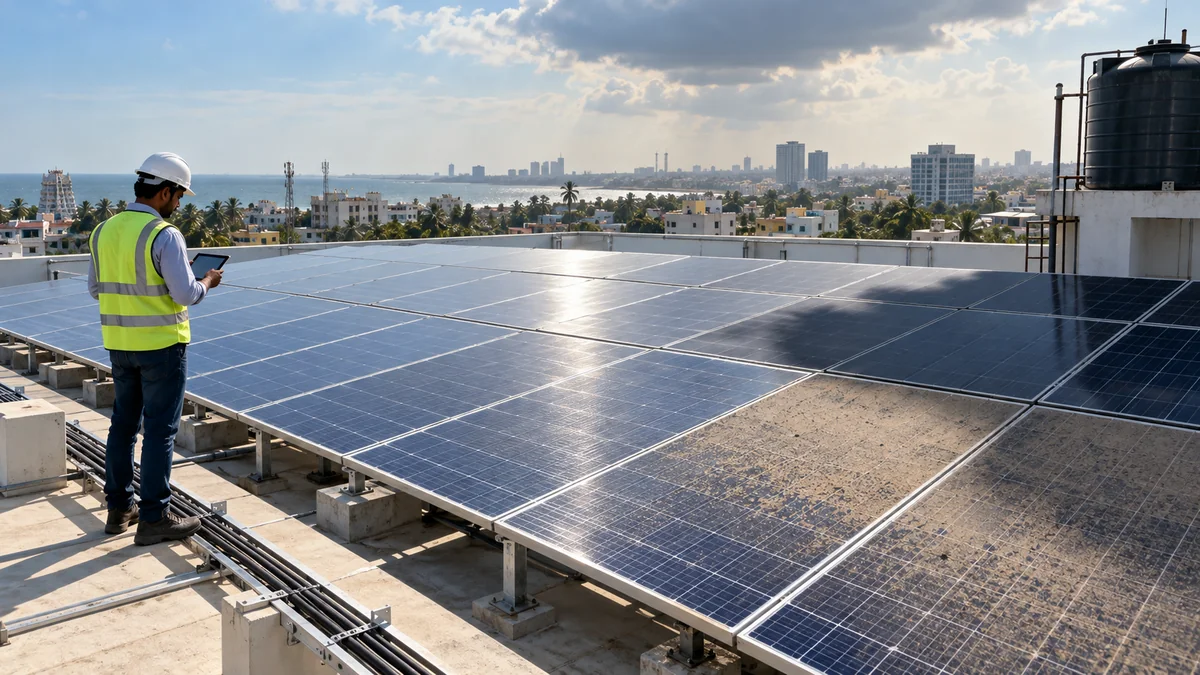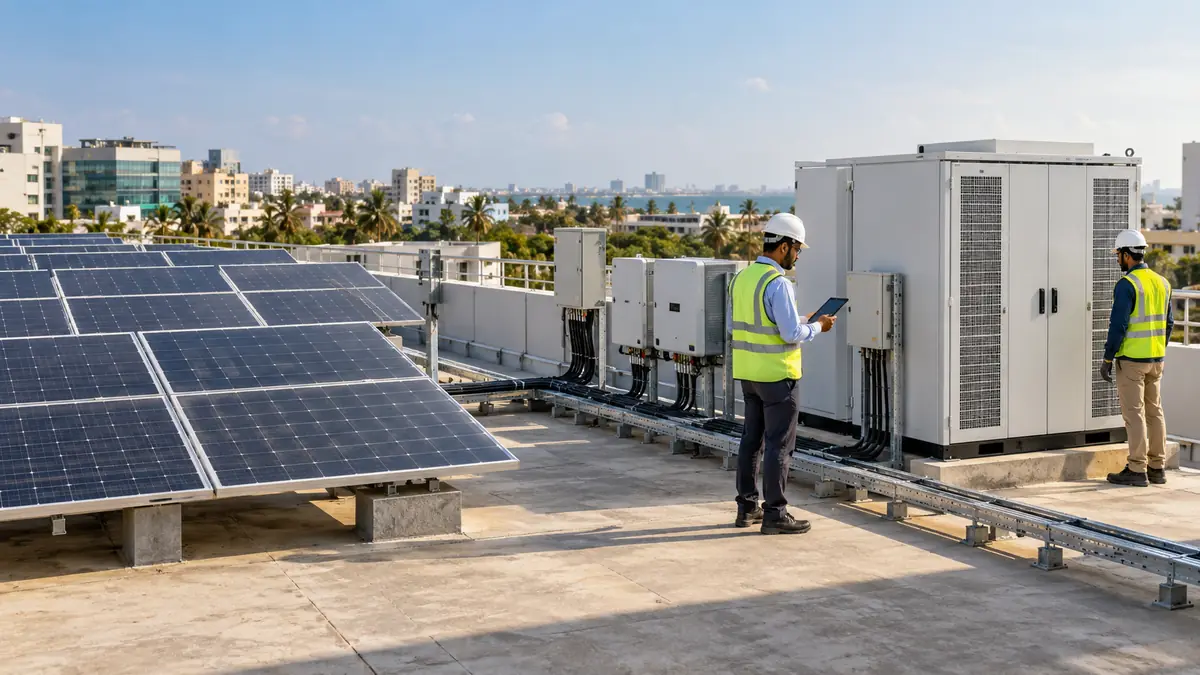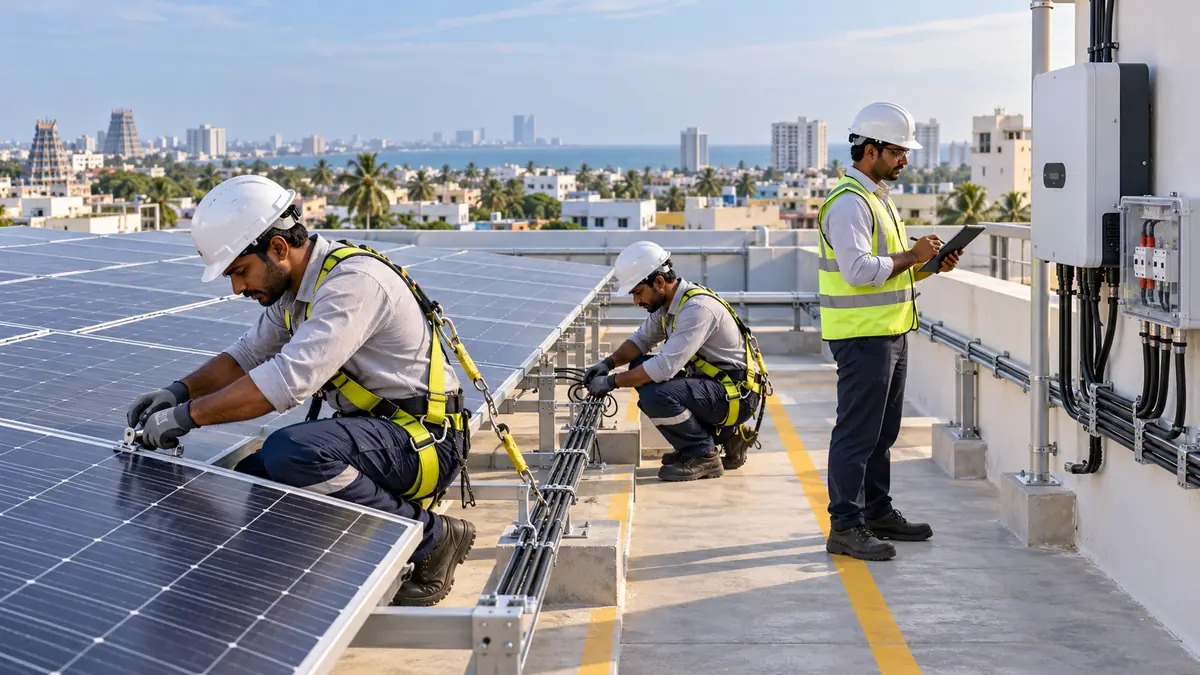
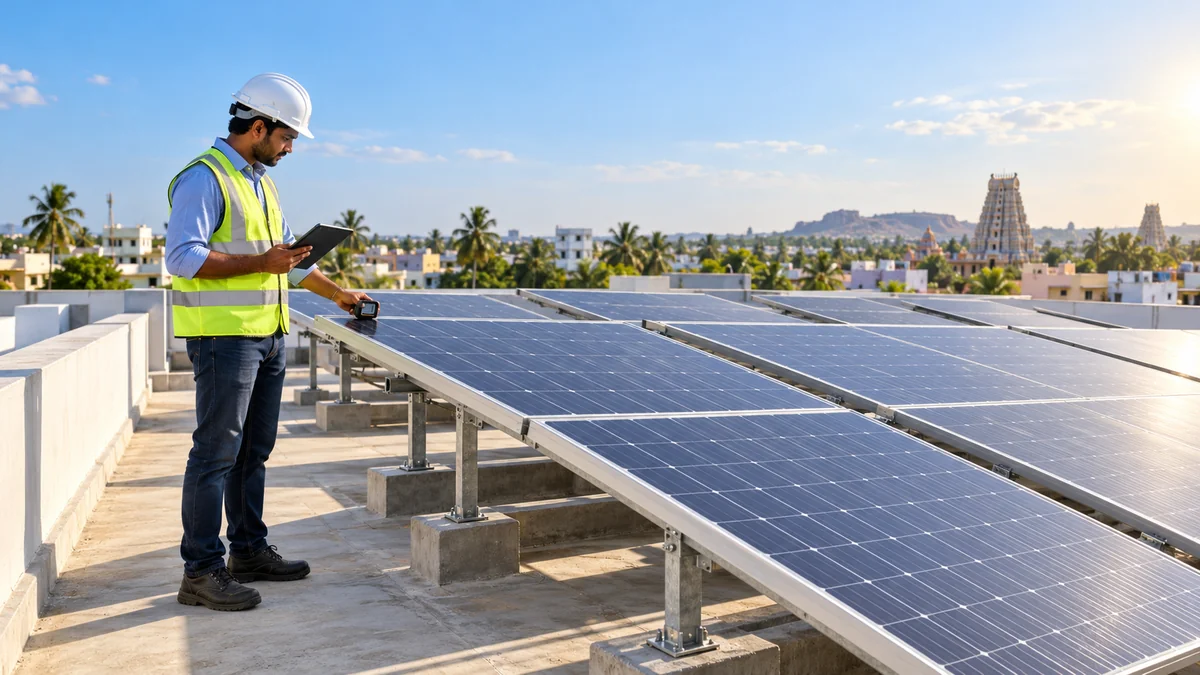
The direction and tilt of a solar array affect how much sunlight reaches its surface through the day and across the seasons. In Tamil Nadu, a fixed array generally faces true south when maximum annual generation is the primary objective. A shallow tilt close to the site's latitude is often a useful starting point, but it is not the final answer for every roof.
The best layout must also preserve shadow-free space, resist wind, drain rainwater, permit safe cleaning and match the building's electricity use. This guide explains how solar EPC designers should balance those factors in Chennai, Kovilpatti, Madurai, Trichy and Kanchipuram.
What Is the Best Angle and Direction of Solar Panels?
For a fixed solar installation in Tamil Nadu, true south is usually the preferred direction for balanced annual energy. A preliminary tilt range of about 8° to 15° suits many locations in the state, with slightly higher starting values in Chennai and Kanchipuram and slightly lower values in Madurai and Kovilpatti.
Use these values only for early planning. The final design should be based on exact coordinates, roof slope, horizon and shadow analysis, wind loading, row spacing, drainage, module dimensions, inverter design and the customer's load profile.
City-Wise Starting Guide
Chennai
- Approximate latitude: 13° north
- Practical fixed-tilt starting range: 10° to 15°
- Preferred annual-energy direction: true south
- Key design checks: high module temperature, coastal corrosion exposure, parapet and water-tank shade, wind zones and roof access
A tilt near 13° is a sensible simulation starting point, but a designer may use a different value to fit more modules, reduce inter-row shade or suit a sloping roof. Businesses that consume more power in the afternoon may also evaluate a slightly westward orientation instead of optimizing annual energy alone. For project support, see Viryasys' solar EPC services in Chennai.
Kanchipuram
- Approximate latitude: 13° north
- Practical fixed-tilt starting range: 10° to 15°
- Preferred annual-energy direction: true south
- Key design checks: industrial roof profiles, surrounding development, dust, drainage and structural capacity
Kanchipuram's latitude is close to Chennai's, so their initial tilt ranges are similar. The final layouts can still differ substantially because of roof type, nearby structures and the consumer's operating hours. Learn more about local execution on the Kanchipuram solar-company page.
Trichy
- Approximate latitude: 11° north
- Practical fixed-tilt starting range: 8° to 13°
- Preferred annual-energy direction: true south
- Key design checks: high heat, dust accumulation, roof condition, row spacing and wind exposure
A tilt around the low double digits is a useful starting point for Trichy. Very low slopes require careful drainage and cleaning planning, while steeper rows need enough separation to avoid mutual shade. Explore the Trichy solar-company page for local installation context.
Madurai
- Approximate latitude: 10° north
- Practical fixed-tilt starting range: 8° to 12°
- Preferred annual-energy direction: true south
- Key design checks: heat, soiling, ventilation, water availability for maintenance and rooftop obstruction shade
Madurai's lower latitude supports a shallower initial tilt than Chennai. However, reducing tilt purely to pack more modules can make dirt persistence and maintenance more difficult. The Madurai solar-company page provides more information for local buyers.
Kovilpatti
- Approximate latitude: 9° north
- Practical fixed-tilt starting range: 8° to 12°
- Preferred annual-energy direction: true south
- Key design checks: strong wind, dust, open terrain exposure, mounting strength and maintenance access
Kovilpatti's latitude suggests a relatively shallow fixed tilt, but wind exposure can be a decisive structural factor. Mounting and foundation design must be based on the actual site and applicable engineering standards, not copied from another city. See the Kovilpatti solar-company page.
Why True South Is Usually Preferred
Tamil Nadu is in the Northern Hemisphere. A true-south-facing fixed array receives a balanced solar path across the year and often maximizes annual energy for an unshaded site.
“True south” means the direction toward the geographic South Pole. It is not always identical to the south shown by an uncompensated magnetic compass. Metal structures, electrical equipment and local magnetic variation can affect compass readings. Professional layouts should use reliable survey or mapping methods and verify the direction on site.
South is not mandatory. A well-designed east-west or southeast-southwest array can outperform a nominally south-facing design if the latter suffers from shade, poor spacing or insufficient usable area.
When East-West Orientation Can Be the Better Business Choice
An east-west layout distributes generation across the morning and afternoon. On flat roofs, it may allow more installed capacity with lower opposing tilt angles and reduced row-spacing requirements.
Consider east-west when:
- The roof cannot accommodate a conventional south-facing layout.
- Electricity demand is broad through the working day.
- Higher total roof capacity is more valuable than peak output per module.
- Wind or height constraints favour a lower-profile structure.
- The system is export-limited and self-consumption timing matters.
The comparison should use simulated annual generation, hourly load data, shading and total installed capacity. It should not be decided from direction alone.
Should Panels Face West for Afternoon Loads?
A westward bias moves more generation into the afternoon, which may help facilities whose demand peaks later in the day. It normally gives up some annual energy compared with an ideal true-south layout, but the electricity may be more valuable if it offsets higher afternoon consumption or improves self-consumption.
Similarly, an eastward bias can support early operational loads. Commercial design should evaluate the match between generation and the interval load curve, not just the highest annual kilowatt-hour estimate.
Why “Tilt Equal to Latitude” Is Only a Starting Rule
The latitude rule is useful because it roughly aligns a fixed surface with the sun's average annual path. Yet an EPC designer may intentionally move away from it for valid reasons:
- A lower tilt can fit more modules on a constrained flat roof.
- A higher tilt may improve drainage and make manual cleaning easier.
- Existing roof slope or shed orientation may dominate the layout.
- Row-to-row shade may reduce the benefit of a theoretically ideal tilt.
- Wind loading can rise with greater tilt and edge exposure.
- Morning or afternoon load matching may justify a different azimuth.
- Seasonal generation targets may differ from annual optimization.
The best angle is therefore the one that maximizes project value within safety and site constraints, not necessarily the one closest to a generic formula.
Five Design Factors More Important Than a One-Degree Difference
1. Shadow-free solar access
A few degrees of tilt optimization cannot compensate for recurring shade from tanks, parapets, trees or adjacent rows. A seasonal shadow study should come first.
2. Inter-row spacing
As tilt increases, the row casts a longer shadow. Rows need sufficient space based on module height, tilt, sun position and the design's acceptable shading window.
3. Structural and wind safety
The array adds dead load and experiences wind uplift. Roof condition, fasteners, ballast, building height and edge zones require engineering review. Kovilpatti's open terrain and Chennai's coastal exposure illustrate why a copied mounting design is unsafe.
4. Drainage and soiling
Water and dirt should not remain trapped at module edges. A shallow layout may work well, but it needs good drainage and a realistic cleaning plan. Read how external conditions affect solar-panel performance when that supporting article is published.
5. Safe access
Technicians need walkways, setback space and access to strings, isolators and drainage paths. Filling every square metre with modules can raise lifetime operating cost and safety risk.
Flat Roof, Sloping Roof and Ground-Mounted Differences
Flat RCC roofs
Flat roofs allow the designer to select tilt and direction, but usable area is reduced by setbacks, access paths, obstructions and row spacing. The mounting method must protect waterproofing and structural integrity.
Sloping metal roofs
Modules are commonly mounted close and parallel to the existing roof plane to control wind loads and simplify attachment. Changing orientation may require additional structure and may not deliver enough extra energy to justify it.
Ground-mounted systems
Ground projects offer more layout flexibility but need geotechnical review, foundations, roads, drainage, boundary security, row spacing and evacuation planning. Land shape and substation access may influence orientation as much as latitude.
How a Solar EPC Team Selects the Final Layout
A credible design process includes:
- Measure the exact site and usable area.
- Map obstructions and the horizon.
- Model seasonal shadows.
- Review roof structure or soil and foundation conditions.
- Analyse the customer's interval electricity use.
- Compare south-facing, east-west and roof-parallel options.
- Simulate generation and electrical losses.
- Check row spacing, wind, drainage and maintenance access.
- Finalize module strings, inverter loading and cable routes.
- Document assumptions in the proposal and generation estimate.
Before accepting a proposal, buyers should use the checklist for selecting a solar installation company in Chennai and ask for the layout, shadow assumptions and generation model.
Mistakes to Avoid
- Treating magnetic compass south as verified true south
- Copying a tilt angle from another city or roof
- Ignoring winter and early-morning shadows
- Increasing tilt without checking row spacing and wind load
- Choosing the direction only from annual energy, without studying the load curve
- Blocking drainage or eliminating maintenance walkways
- Accepting a generation promise that does not state assumptions
- Assuming a south-facing array is automatically shade-free
Conclusion
For most fixed solar systems in Tamil Nadu, true south and a shallow tilt near local latitude form a good design starting point. That usually means approximately 10° to 15° in Chennai and Kanchipuram, 8° to 13° in Trichy, and 8° to 12° in Madurai and Kovilpatti.
These are not installation instructions or guaranteed optimum values. The winning design is the layout that safely produces useful energy on the actual site after accounting for shade, roof or soil conditions, wind, drainage, row spacing, access and the customer's consumption profile.
Viryasys Technologies can conduct the site survey, simulation and engineering needed for a project-specific solar solution in Chennai or across the five Tamil Nadu locations covered in this guide.