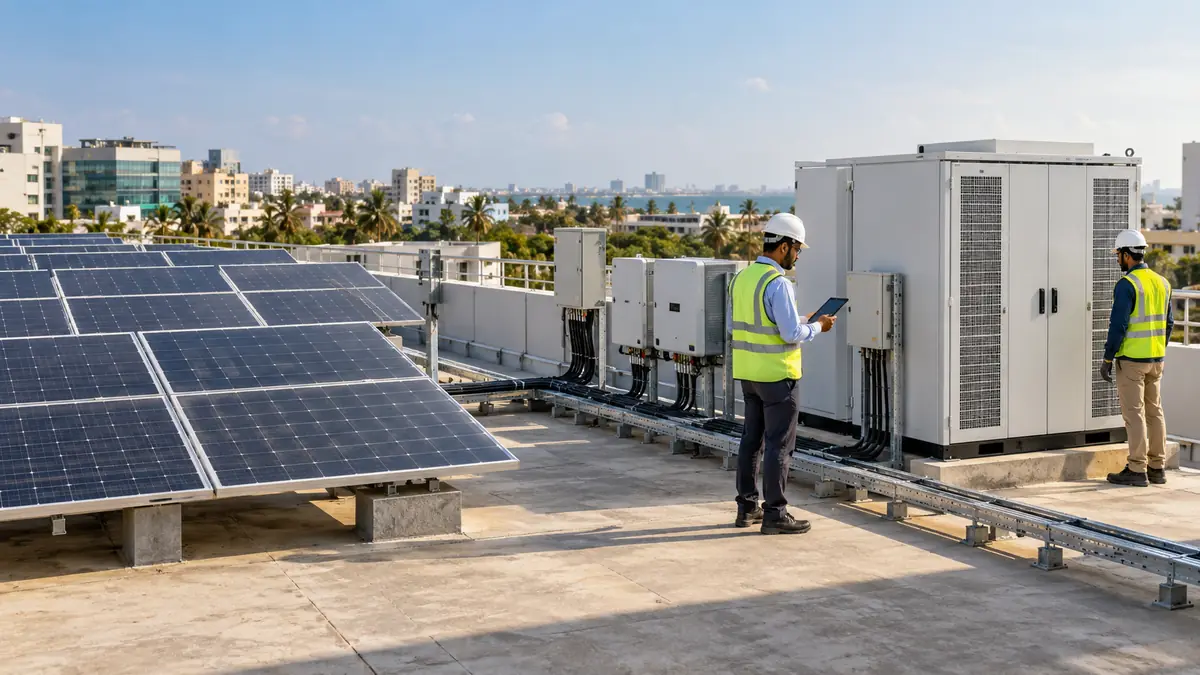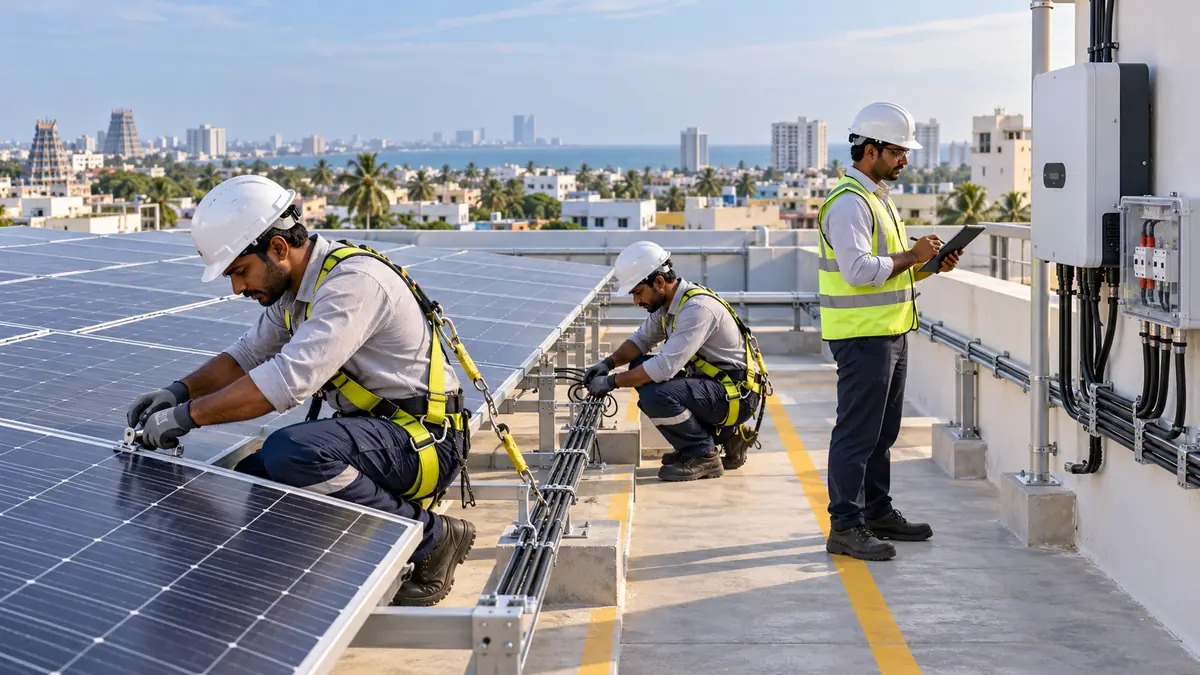
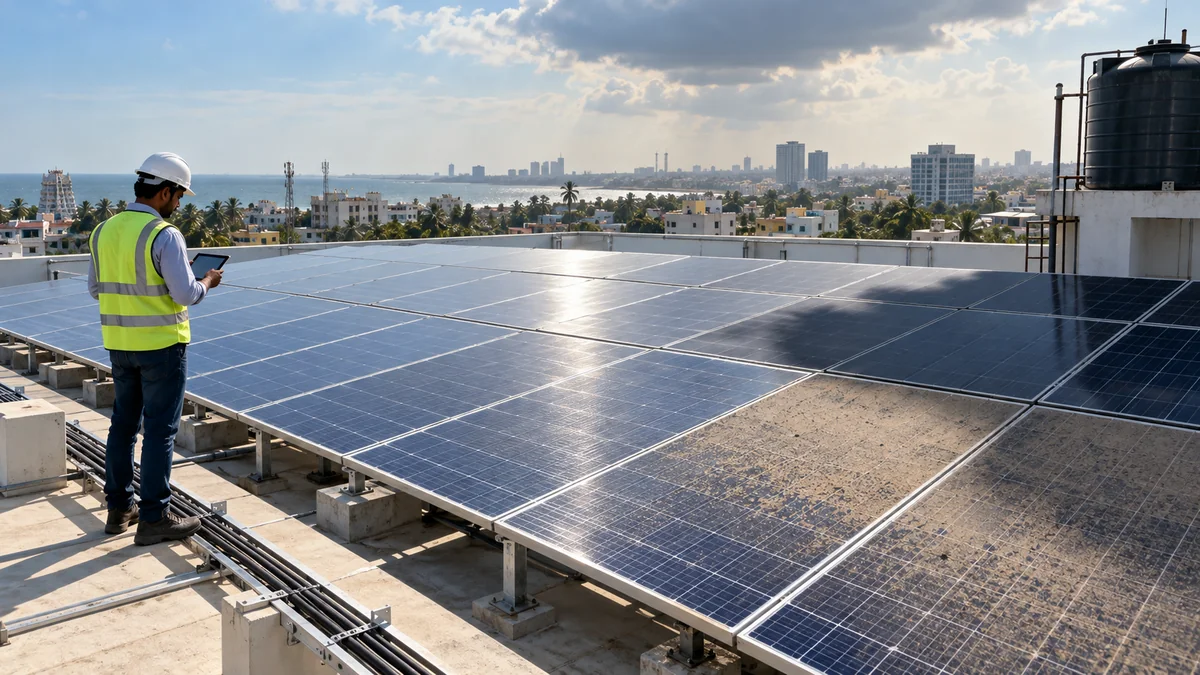
Solar panels do not produce the same amount of electricity every hour or every day. Their output changes with sunlight, module temperature, shade, dust, humidity, wind, rain and the condition of the electricity grid. These changes are not automatically signs of a defective system.
For solar owners in Chennai, the useful question is not simply, “Did generation fall?” It is: “Did generation fall by more than the weather and operating conditions can reasonably explain?” Answering that question requires comparing like with like, identifying the timing of the loss and checking the system in a logical order.
Which External Factors Affect Solar Output Most?
The most important external factors are solar irradiance, module temperature, shading, dust or other soiling, seasonal cloud cover, humidity, wind, rain, roof geometry and grid availability. Strong sunlight increases the energy available to a panel, but very high module temperatures reduce its conversion efficiency. Shade and dirt restrict the light reaching cells, while grid interruptions can stop a grid-connected inverter even when the sun is shining.
In practice, the largest preventable losses often come from persistent shade, accumulated soiling, blocked ventilation, poor drainage, vegetation growth or an unresolved grid or inverter issue. Normal day-to-day weather variation should be separated from these correctable causes.
1. Solar Irradiance: The Main Input to the System
Solar irradiance is the amount of solar energy reaching the panel surface. More usable irradiance generally means more generation, subject to the system's rated capacity and inverter limits.
Irradiance changes because of:
- Time of day and the sun's position
- Seasonal changes in day length and sun path
- Clouds, haze and atmospheric pollution
- The panel's angle and direction
- Nearby objects that block direct or diffuse sunlight
A clear midday period usually produces more power than an overcast morning, but daily energy is more useful than a single power reading. A brief cloud can cause a sharp dip that is completely normal. A recurring dip at the same time on clear days points more strongly to shade or a design constraint.
2. Heat: Bright Sun Does Not Always Mean Maximum Efficiency
Solar modules are tested under standard laboratory conditions, including a cell temperature of 25°C. On a Chennai rooftop, cell temperature can be far higher than ambient air temperature, especially around noon on a low-wind day.
As crystalline-silicon cells get hotter, their voltage falls and conversion efficiency declines. A module's datasheet states this behaviour as a temperature coefficient, commonly expressed as a percentage change per degree Celsius above the reference condition. The exact value depends on the module model; it should be taken from the selected product's datasheet, not assumed from a generic percentage.
This creates an important distinction:
- A hot, cloudless day may deliver high total energy because sunlight is strong.
- At the same irradiance, a cooler module can operate more efficiently than a very hot one.
Good rear ventilation, appropriate mounting clearance and a layout that avoids heat traps help modules release heat. Pouring cold water onto hot panels is not an efficiency strategy and may create thermal stress or safety risks.
3. Partial Shading: A Small Shadow Can Cause a Disproportionate Loss
Shade may come from water tanks, parapet walls, antennas, nearby buildings, trees, utility structures or even another row of modules. Its effect depends on which cells are covered, how modules are connected and how the inverter tracks power.
Because cells are electrically interconnected, a narrow shadow across part of a module can affect more than the shaded area alone. Bypass diodes reduce damage and limit some loss, but they do not make shading irrelevant.
Look for three shade patterns:
Fixed structural shade
This repeats predictably from tanks, walls, columns or neighbouring buildings. A shadow study should identify it before design.
Seasonal shade
The sun's path changes through the year, so an obstruction that appears harmless in one month may shade modules in another.
New or growing shade
Tree growth, new construction, rooftop equipment and hoardings can change conditions after commissioning.
When shade cannot be eliminated, string design, module-level electronics or a revised layout may reduce its impact. Those choices should follow an engineering assessment rather than be treated as automatic upgrades.
4. Dust, Bird Droppings and Other Soiling
Dust creates a layer between sunlight and the solar cells. Chennai systems may also encounter construction dust, traffic residue, pollen, leaves, coastal deposits and bird droppings. Uniform light dust tends to cause a gradual loss; concentrated deposits can create uneven electrical stress and hot spots.
The impact depends on:
- How quickly contamination accumulates
- Whether rain removes or redistributes it
- Panel tilt and drainage
- Local construction, traffic and vegetation
- Cleaning method and frequency
There is no responsible universal rule that every system loses the same percentage after the same number of days. A practical cleaning plan should be based on inspection, generation trends, rainfall and site conditions. The solar-panel maintenance guide explains how to build a safe, site-specific schedule.
5. Rain: Cleaning Benefit and Temporary Output Reduction
Rain and heavy cloud cover usually reduce generation while the weather event is occurring. However, useful rain can wash away loose dust and improve output afterwards. Light rain may only turn dust into streaks or leave deposits near the lower frame edge.
After the monsoon or a major storm, inspect:
- Whether water drains freely from the module edge
- Whether leaves or mud have collected near clamps
- Whether cable routes or junction boxes have been disturbed
- Whether generation returns to its expected weather-adjusted level
Cleaning should never be performed during lightning, rain, unsafe roof conditions or while electrical components are wet.
6. Humidity, Salt and Coastal Exposure
Humidity does not simply “switch off” a solar panel, but persistent moisture and coastal contaminants can challenge materials over time. Connectors, junction boxes, fasteners, earthing components and mounting structures must suit the site environment and be installed correctly.
For buildings exposed to coastal air, project design should consider:
- Corrosion-resistant mounting and fasteners
- Correctly rated enclosures and glands
- Compatible connectors with sound crimping
- Cable management that avoids standing water
- Planned inspection for corrosion, moisture entry and insulation issues
Avoid assuming that any system labelled “weatherproof” will perform indefinitely without inspection. Product ratings, workmanship and preventive maintenance all matter.
7. Wind: Cooling Benefit and Structural Responsibility
Airflow can cool module surfaces and partly reduce temperature-related losses. At the same time, strong wind creates uplift and vibration loads on the array.
A system should never trade structural safety for extra ventilation. The mounting design must account for building height, edge and corner zones, roof condition, local wind exposure, module orientation, fasteners and ballast or anchoring method. Loose clamps, cable movement and damaged seals should be corrected by qualified personnel.
8. Panel Angle, Direction and Row Spacing
Angle and direction determine how directly sunlight reaches the array over the year. In Tamil Nadu, a fixed array commonly faces true south when annual energy is the main goal, but the best design also depends on roof shape, usable area, shadow-free spacing, wind, drainage and the building's daytime load.
Poor row spacing can cause one row to shade the next when the sun is lower. A very low tilt may increase the number of modules that fit, yet it can reduce self-cleaning and make standing dirt more persistent. A steep tilt can reduce packing density and increase wind loads.
Read the detailed Tamil Nadu solar-panel angle and direction guide when it is published, or ask the Viryasys solar EPC team in Chennai for a site-specific layout and generation simulation.
9. Grid Availability and Voltage Quality
A conventional on-grid inverter is designed to stop exporting power when the grid fails. This anti-islanding behaviour protects utility workers and equipment. Therefore, a sunny day can still show zero production during a grid outage unless the system includes a correctly designed backup architecture.
Repeated high or low grid voltage, frequency variation or protection trips may also disconnect the inverter. The monitoring portal may record these events as grid faults rather than solar-resource losses.
If reliable backup is important, compare on-grid, off-grid and hybrid solar systems and assess whether a compatible battery system fits the load profile.
10. Inverter Clipping, Conversion and Operating Limits
Not every flat-topped production curve represents a fault. When DC array power temporarily exceeds the inverter's AC output limit, the inverter may cap output at its rated capacity. This is called clipping and can be an intentional design trade-off.
Other operating limits can arise from:
- High module or inverter temperature
- Grid voltage outside the permitted range
- Export limits or zero-export controls
- MPPT configuration
- String mismatch or a disconnected string
- Equipment derating or alarms
The correct interpretation needs the system design, event log and weather conditions. Owners should not change inverter protection settings or open electrical enclosures themselves.
External Factors Often Work Together
Real-world losses rarely occur in isolation. Examples include:
- Dust plus high heat: soiling blocks light while dark deposits may increase local heating.
- Low tilt plus light rain: water moves dirt but may not remove it, leaving streaks.
- Shade plus string mismatch: a shaded section can constrain other modules on the same electrical path.
- Heat plus weak ventilation: rooftop geometry traps hot air behind modules.
- Coastal moisture plus poor connector installation: environmental exposure accelerates a workmanship weakness.
This is why replacing a module based on one low reading is risky. Diagnose the pattern first.
How to Tell Normal Variation from a Real Problem
Use this measurement sequence:
- Compare daily energy, not only instantaneous power.
- Compare similar clear-weather days in the same season.
- Check whether all strings or MPPT channels behave similarly.
- Review inverter warnings, grid events and communication gaps.
- Inspect for new shade, dirt, leaves, damage or standing water.
- Compare actual generation with the design estimate after allowing for weather.
- Arrange professional testing if the gap persists.
A monitoring app can lose communication even while the inverter continues generating. Confirm whether the issue is missing data, an inverter shutdown or genuinely low energy. The guide on why a solar system may not produce enough power provides a broader troubleshooting path.
What Chennai Solar Owners Can Control
Weather cannot be controlled, but many consequences can be managed:
- Keep the array free from persistent shade.
- Use monitoring alerts and review monthly generation.
- Set cleaning frequency according to actual soiling and rainfall.
- Keep the rear of modules ventilated.
- Maintain drainage and remove leaf accumulation.
- Schedule electrical and structural inspections.
- Record changes such as nearby construction or tree growth.
- Preserve commissioning reports, string data and equipment datasheets.
Before installation, good design matters even more. A detailed survey should assess roof condition, shadows, cable routes, drainage, wind exposure, access and the consumer's load pattern. Use the installer-selection checklist for Chennai to compare EPC proposals beyond price.
When Should You Call a Solar Professional?
Request professional support when:
- An inverter displays repeated grid, insulation or temperature faults.
- One string consistently underperforms comparable strings.
- Generation remains unusually low after weather and soiling are considered.
- There are burn marks, damaged cables, loose mounting parts or water entry.
- Cleaning requires unsafe roof access.
- A new obstruction or rooftop modification changes the layout.
Do not touch exposed conductors, disconnect live DC equipment or alter inverter protection settings. Solar arrays can remain electrically live in daylight even when the AC supply is switched off.
Conclusion
External conditions influence every solar system, but they do not all have the same effect or require the same response. Sunlight determines the available energy; heat affects conversion efficiency; dust and shade block usable light; humidity and wind shape long-term design requirements; and grid conditions can stop an on-grid inverter altogether.
The most reliable approach is to use monitoring data, compare similar conditions and investigate persistent patterns. Viryasys Technologies can assess shade, layout, equipment, monitoring and maintenance requirements for homes, apartments and businesses seeking a professionally engineered solar solution in Chennai.