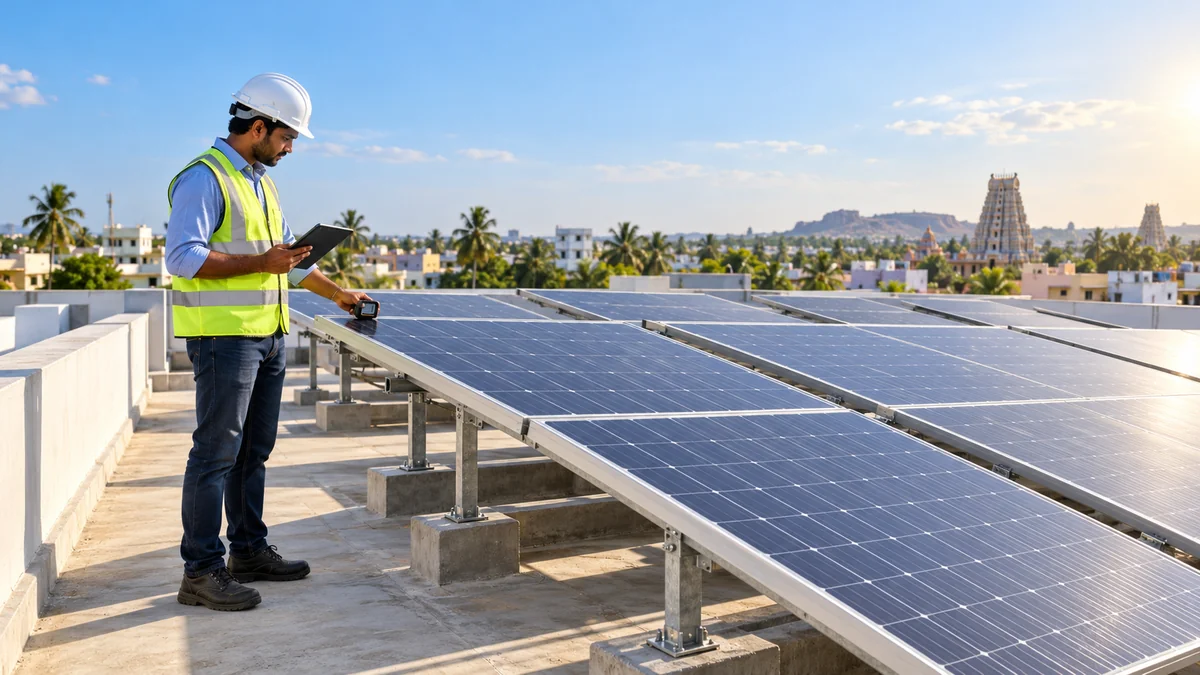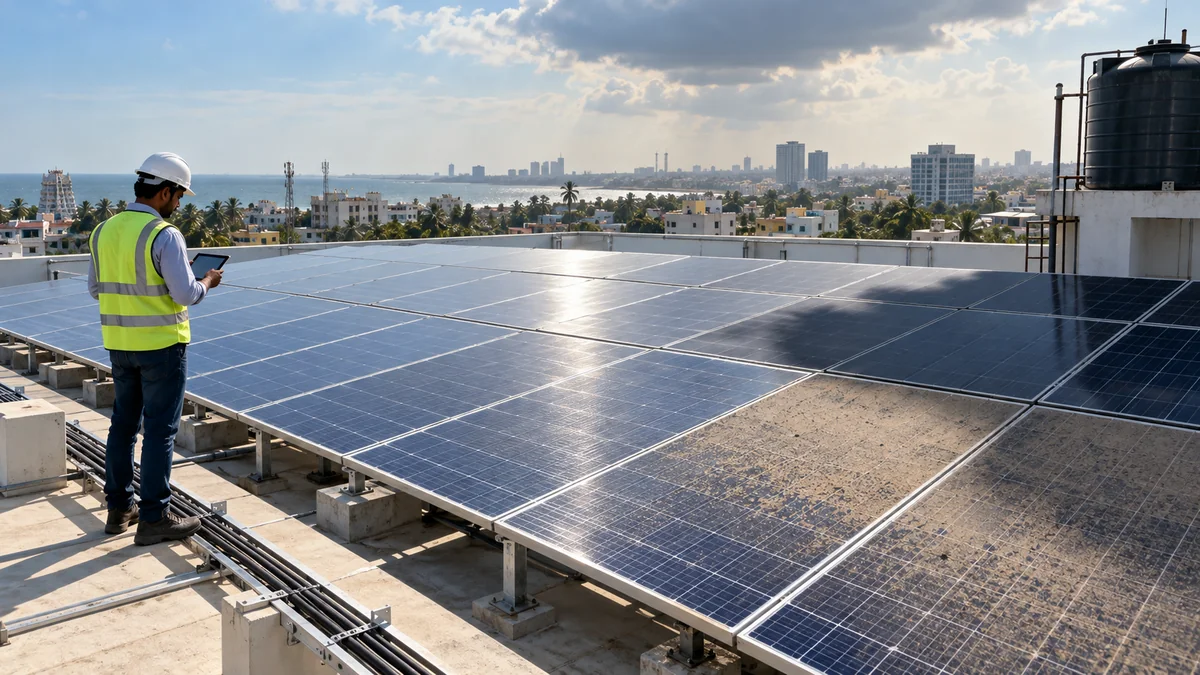
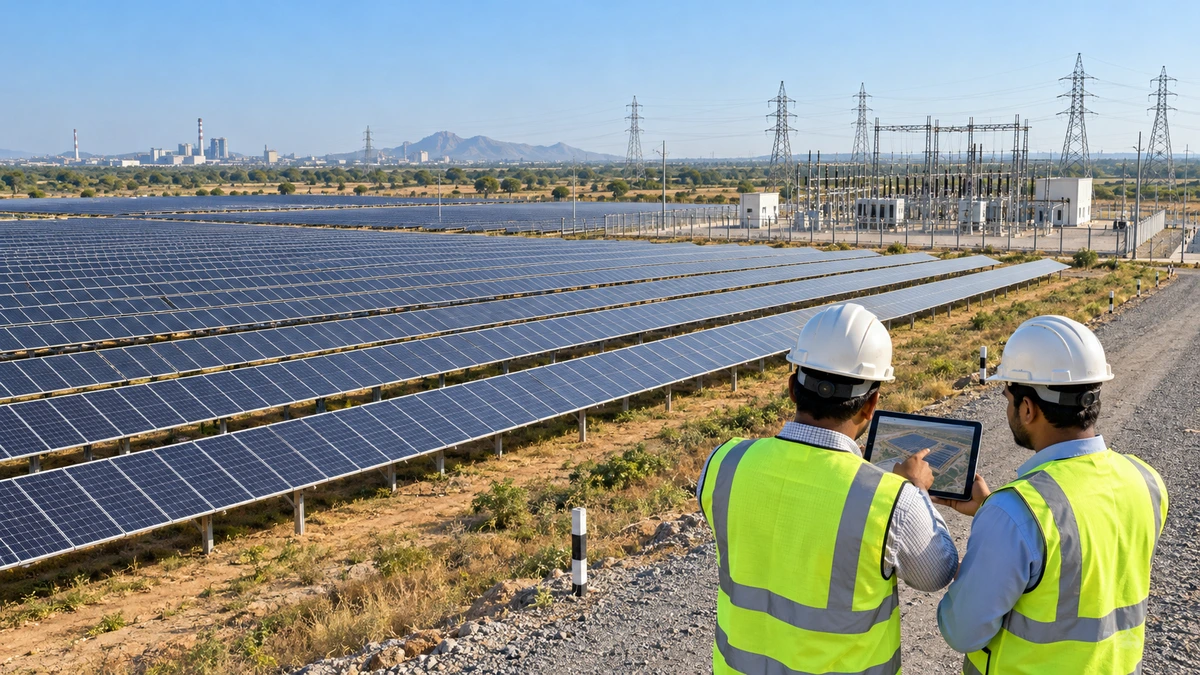
Many Chennai factories, offices, hospitals, campuses and logistics facilities want more solar energy than their roofs can accommodate. A ground-mounted open-access project can generate power at a remote site and deliver eligible energy through the electricity network to the consumer's connection.
The solar plant does not have to be inside Chennai. In fact, land availability, solar resource and evacuation infrastructure may make another Tamil Nadu location more suitable. What matters is whether the complete route, from project land to grid interconnection to the Chennai consumer, is technically feasible, commercially valuable and compliant with current regulations.
Accuracy note: Eligibility, charges, banking, connectivity and approval procedures can change. Verify the current TNERC, TNPDCL, TANTRANSCO and other applicable requirements for the specific project before investment.
What Is Ground-Mounted Open-Access Solar?
A ground-mounted solar system installs modules on structures anchored to land rather than on a building roof. In an open-access arrangement, an eligible consumer procures electricity from that project through the grid under an approved third-party, captive or group-captive structure.
The project requires more than land and modules. It needs clear land rights, suitable terrain, engineering studies, grid connectivity, an evacuation line, protection and metering, approvals, forecasting and scheduling, a bankable commercial agreement and an offtaker whose demand matches the expected supply.
How Electricity Reaches a Chennai Consumer
The physical and commercial chain generally includes:
- Solar modules produce DC electricity at the remote plant.
- Inverters convert it to AC power.
- Transformers raise voltage to the approved evacuation level.
- The project connects through a dedicated line or approved network point.
- Special meters record injection into and drawal from the grid.
- Scheduling and energy accounting allocate eligible power to the consumer.
- The consumer's bill and project invoice reflect the applicable settlement structure.
Electricity is not transported as a labelled batch of electrons. The grid carries power collectively; meters, schedules and settlement records establish the commercial delivery.
Why Chennai Businesses Consider This Model
Ground-mounted open access may be attractive when:
- Rooftop area is too small for the required capacity.
- Roof structure, shade or tenancy limits onsite solar.
- The consumer has a stable, substantial daytime load.
- Multiple facilities need to be considered under an eligible structure.
- The business wants long-term renewable-energy procurement.
- A larger remote plant can achieve useful scale.
It is not automatically cheaper than rooftop solar. Network charges, losses, land, evacuation, approvals and transaction costs must be included in the analysis.
Rooftop Solar Versus Ground-Mounted Open Access
Rooftop solar
- Uses the consumer's premises
- Commonly offsets behind-the-meter consumption directly
- Limited by roof area, structure, shade and tenancy
- Usually has fewer remote-delivery components
- Requires coordination with ongoing building operations
Ground-mounted open-access solar
- Uses remote land and can support larger capacity
- Requires grid connectivity and commercial energy accounting
- Introduces land, evacuation, scheduling and regulatory workstreams
- May serve long-term C&I demand beyond roof potential
- Requires careful landed-cost and counterparty analysis
Some consumers use both: rooftop solar for direct onsite savings and open-access supply for the remaining eligible load. The industrial rooftop solar guide helps establish the onsite opportunity before considering remote capacity.
Three Feasibility Tests Before Development
1. Technical feasibility
Can the land, plant, evacuation system and buyer connection support the proposed capacity? This includes solar resource, soil, flooding, topography, interconnection, line route, protection, metering and power-quality studies.
2. Commercial feasibility
Will delivered solar energy create value after capital cost, financing, land, O&M, grid charges, losses, compliance and backup electricity are considered? Is the buyer's load stable enough for the plant profile?
3. Regulatory feasibility
Does the consumer qualify under the current rules? Can the chosen third-party, captive or group-captive structure meet ownership, consumption, connectivity, scheduling and settlement requirements throughout the term?
A project should pass all three. A strong solar resource cannot rescue an unavailable evacuation bay, and a low generation tariff cannot rescue a non-compliant commercial structure.
Land Selection: More Than Acres per Megawatt
Land demand varies with module technology, row spacing, terrain, drainage, roads, setbacks, substation, inverter stations and environmental constraints. A generic acres-per-megawatt figure should not be used to purchase land before a layout is developed.
Screen land for:
- Clear title, ownership history and encumbrances
- Permitted land use and conversion requirements
- Contiguous shape and usable area
- Flood, drainage and water-flow patterns
- Soil bearing capacity and corrosivity
- Topography and grading needs
- Road access for construction and maintenance
- Security and boundary requirements
- Proximity and route to the connection point
- Environmental, community and right-of-way constraints
The cheapest parcel can become the most expensive if evacuation distance, civil work or title risk is high.
Solar Resource, Tilt and Array Layout
The plant design should model long-term irradiance, temperature, wind, soiling and seasonal variation. Tamil Nadu's low latitude usually supports a relatively shallow fixed tilt, but the site-specific choice depends on energy yield, row shade, land use, wind, drainage and cleaning.
Layout decisions include:
- Fixed-tilt versus tracking system
- Module orientation and row pitch
- Inverter-block sizing and DC/AC ratio
- Internal roads and stormwater routes
- Cable trench and earthing design
- Transformer and pooling-station location
- Maintenance access and vegetation control
The detailed Tamil Nadu solar-panel angle guide explains why latitude is a starting point rather than a complete design.
Fixed Tilt or Solar Tracker?
Fixed-tilt structures
They have fewer moving parts, simpler foundations and generally lower maintenance complexity. They remain a common choice where reliability, land and capital discipline are priorities.
Single-axis trackers
Trackers rotate modules through the day to increase energy capture, but they add mechanical systems, control logic, stow strategies, larger movement envelopes and maintenance requirements.
Choose by comparing additional generation against added capital cost, land configuration, wind conditions, soil, O&M capability and downtime risk. A tracker is not automatically better for every Tamil Nadu site.
Grid Connectivity and Evacuation: The Early Critical Path
Grid evacuation can determine whether the project is viable. Before committing major capital, assess:
- Available capacity at the proposed connection point
- Required voltage level and interconnection configuration
- Substation bay availability and upgrade needs
- Dedicated-line length and right of way
- Protection, communication and metering requirements
- System studies and approval sequence
- Estimated cost and completion schedule
- Responsibility for ownership and maintenance of evacuation assets
Distance to a transmission line on a map does not confirm connectivity. The relevant authority must assess the actual network and project application.
Open-Access Commercial Structures
Third-party PPA
An independent generator sells solar electricity to the consumer under a power purchase agreement. The buyer avoids direct plant ownership but must review tariff, delivery, change-in-law, security and termination exposure.
Captive project
One consumer participates as an owner and consumes power under the applicable captive requirements. Ownership and consumption compliance must be maintained.
Group-captive project
Multiple consumers participate. The structure introduces allocation, governance, exit and continuing-compliance considerations in addition to project performance.
The article on solar power purchase agreements should be cross-linked after publication for a detailed contract checklist.
Calculate Delivered Cost, Not Only Generation Cost
A commercial model should show a year-by-year cost waterfall:
- Plant energy price or ownership cost
- Approved transmission and wheeling losses
- Applicable network and system-operation charges
- Banking treatment and unused-energy risk
- Forecasting, scheduling and deviation costs
- Metering and communication charges
- Cross-subsidy or additional surcharge where applicable
- Taxes, duties and levies
- Security and financing costs
- Replacement utility power during non-delivery
Rules and charge treatment depend on the project and can change. Use current orders and professional advice when modelling the investment.
Match the Solar Profile to the Buyer's Load
Annual consumption alone is insufficient. Review interval or time-block data to understand:
- Daytime base load
- Weekly and seasonal shutdowns
- Demand growth or contraction
- Multiple-shift operation
- Existing rooftop or captive generation
- Contract-demand constraints
- Export, banking and lapse exposure
An oversized project can create surplus energy that cannot be used or economically settled. A conservative load match is often more valuable than maximizing installed megawatts.
Use the solar-system sizing guide for the underlying load-analysis principles, then extend the model to the relevant open-access settlement periods.
Engineering Scope of a Ground-Mounted EPC Project
A complete EPC scope may cover:
- Detailed survey, geotechnical investigation and topography
- Civil design, grading, drainage, roads and foundations
- Module mounting structures
- Modules, inverters, transformers and switchgear
- DC, AC and communication cabling
- Earthing and lightning protection
- Pooling substation and evacuation infrastructure
- SCADA, weather station and revenue-meter integration
- Testing, grid synchronization and performance demonstration
- Documentation, training and handover
Clarify exclusions. Land, statutory fees, external transmission works, security, water, taxes and long-term O&M may sit outside the quoted EPC price.
O&M Requirements After Commissioning
Utility-scale and C&I ground plants need planned operations, including:
- Remote monitoring and alarm triage
- Module cleaning based on soiling and water strategy
- Vegetation and pest control
- Thermography and electrical testing
- Inverter, transformer and switchgear maintenance
- Structure, torque and corrosion inspection
- Drain and road maintenance
- Spares and warranty management
- Meter reconciliation and performance reporting
- Site security and safety systems
Define guaranteed response times, availability calculation, excluded events and reporting data in the O&M agreement.
Key Project Risks and How to Control Them
Land risk
Use legal due diligence, surveys, title verification and documented access and right-of-way rights.
Evacuation delay
Secure feasibility and define responsibility, milestones and dependencies before full construction commitment.
Generation shortfall
Use bankable resource data, independent model review, quality equipment, commissioning tests and transparent monitoring.
Offtaker demand change
Model downside loads and negotiate allocation, transfer or curtailment provisions.
Regulatory change
Use current advice and a clear change-in-law mechanism in project agreements.
Construction and community risk
Plan logistics, drainage, safety, labour, stakeholder engagement and environmental controls early.
Questions to Ask an EPC or Developer
- Is the land title and permitted use verified?
- What is the proposed connection point, and is capacity confirmed?
- Who builds and owns the evacuation line?
- What assumptions drive the energy yield?
- Which losses are included in the model?
- How is the buyer's load matched to the generation profile?
- What is the complete landed-cost calculation?
- Which approvals and charges remain uncertain?
- Who carries delay, curtailment and change-in-law risk?
- What monitoring and settlement data will the buyer receive?
- What security, warranties and performance remedies apply?
- How will the plant be decommissioned or transferred?
Viryasys Technologies can help businesses assess the technical and EPC elements of a solar project serving Chennai. Regulatory, legal, finance and tax work should be completed by the appropriate specialists alongside the engineering review.
Conclusion
Ground-mounted open-access solar can help Chennai businesses procure renewable electricity beyond the limits of their rooftops. Its success depends on the full chain: bankable land, resource and layout, grid evacuation, approval pathway, accurate metering, compatible load, balanced contracts and disciplined O&M.
Start with the consumer's interval demand and the grid connection, not with an arbitrary plant size or a low headline tariff. Then test technical, commercial and regulatory feasibility together. That approach gives decision-makers a more reliable basis for investment and contracting.