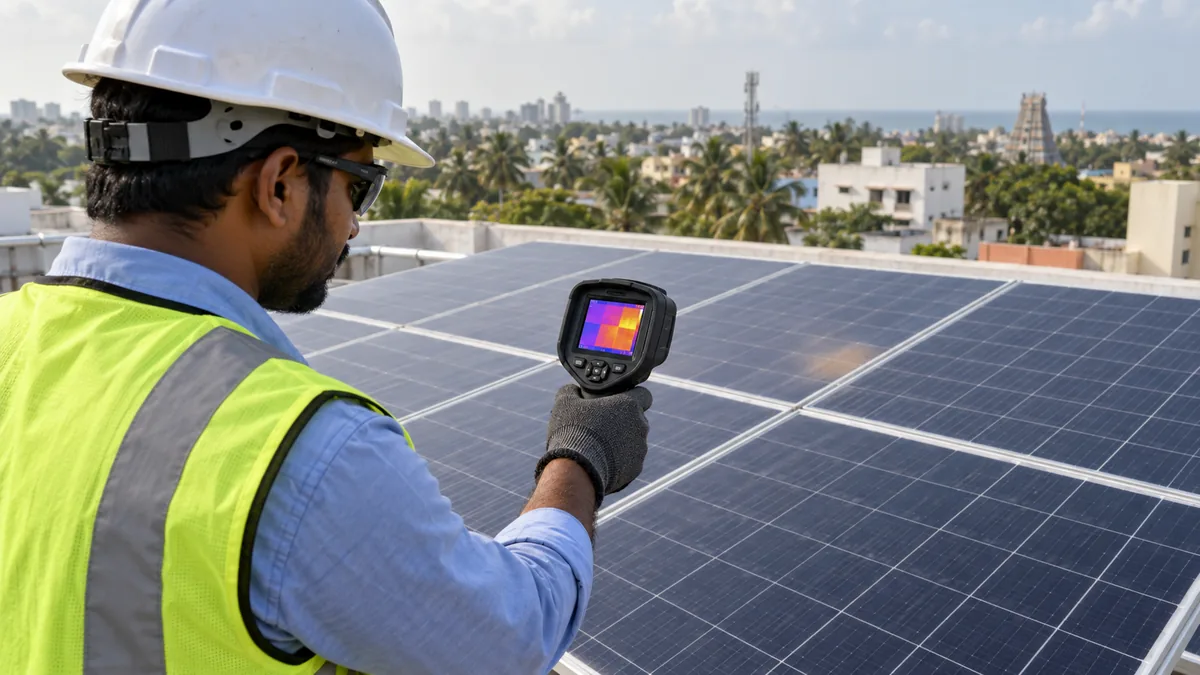

A rooftop solar system begins reducing grid purchases when its power is used inside the property. The approval and metering arrangement determine what happens to electricity that is not consumed immediately and flows into the Tamil Nadu distribution network.
Many people still call the entire process "net metering." For current Tamil Nadu applications, however, TNPDCL's public guidance describes net feed-in billing. That distinction affects how exported electricity is valued, how bills are calculated and how savings should be estimated.
How Does Solar Net Metering Work in Tamil Nadu in 2026?
Apply through the TNPDCL Unified Solar Rooftop Portal. Residential consumers seeking PM Surya Ghar CFA first register on the National Portal and then use that reference with TNPDCL; non-CFA applicants use the TNPDCL route. After approval and installation, the plant is inspected, the agreement is completed and a bidirectional meter records import and export.
For current applications, surplus export is credited at the tariff determined by the regulator, while imported energy is charged at the applicable retail tariff. Because these values differ, maximising daytime self-consumption is usually more valuable than designing a system mainly to export.
Net Metering vs Net Feed-In in Tamil Nadu
Classic net metering adjusts exported kilowatt-hours against imported kilowatt-hours. TNPDCL's FAQ says this treatment applies to solar applications registered before . Mar 24, 2019 For applications registered from that cut-off onward, the published billing method is net feed-in.
Under net feed-in, solar generation first serves loads inside the premises. The bidirectional meter separately records electricity imported from the grid and surplus electricity exported to it. Imported energy is valued at the consumer's retail tariff, while exported energy is credited at the tariff fixed by the Tamil Nadu Electricity Regulatory Commission.
The export credit is adjusted against the import value according to the applicable billing rules. Any balance and end-of-settlement treatment should be checked against the latest regulatory order and bill format. Do not assume that one exported unit cancels one imported unit.
Who Can Apply for Rooftop Solar Grid Connectivity?
The TNPDCL portal supports subsidy-linked residential applications and non-subsidy applications for eligible consumer categories. The service connection, sanctioned load or demand, proposed solar capacity, usable roof and local distribution conditions influence approval.
TNPDCL's FAQ states that rooftop capacity may be selected with reference to sanctioned demand, load requirement and shadow-free roof area, and identifies an upper limit of 150 kW under LT service. A project should not be sized from roof area alone; daytime consumption is equally important.
For apartments, institutions, commercial buildings and factories, confirm the correct consumer category and connection arrangement before applying. A common-facility service, an individual flat service and an industrial service are not interchangeable.
TNPDCL Solar Application Process: Step by Step
- Choose the correct route. CFA-seeking residential consumers register on the National Portal; non-CFA applicants register through the TNPDCL Unified Solar Rooftop Portal.
- Generate the TNPDCL reference. A residential CFA applicant uses the National Portal registration reference in the TNPDCL process.
- Submit service, applicant and project details with the required uploads, then pay the applicable charges shown by the live portal.
- Complete feasibility where required. TNPDCL states that feasibility is waived up to 3 kW of solar applied load; larger applications undergo feasibility review.
- Install only against the accepted capacity, design and conditions, using compliant equipment, protection, earthing and metering arrangements.
- Submit the readiness report after installation so the plant can move to inspection and grid-connectivity review.
- Complete inspection and metering. TNPDCL identifies AEE/O&M inspection up to 10 kW and CEIG inspection above 10 kW before grid connectivity is completed.
- Upload the agreement, plant photograph, DCR information and project-completion records where applicable.
Documents Required for a Tamil Nadu Solar Application
The public TNPDCL document page currently lists a beneficiary photograph and scanned copy of the latest electricity bill for both non-CFA and PM Surya Ghar applications. It also refers to pre-installation site photographs.
Further records are created or requested as the project advances. Keep these items ready:
- Applicant photograph in the prescribed file size and format
- Latest electricity bill and correct service-connection number
- National Portal reference for a PM Surya Ghar CFA application
- Pre-installation and completed-plant photographs, including geo-tagged images where required
- Approved capacity, single-line diagram and equipment details
- Module, inverter, serial-number and DCR records for a subsidy-linked plant
- Inspection report, metering agreement and project-completion report
- Bank evidence and other National Portal documents required for CFA release
- Portal fields and file-size limits can change. Check the live upload page before scanning documents, and ensure the consumer name and account details match across the electricity bill, application and bank evidence.
How Feasibility, Inspection and the Bidirectional Meter Work
Feasibility confirms whether the proposed capacity can be accommodated on the service and local network. A waiver for a smaller system does not waive equipment, protection, inspection, safety or metering requirements.
After the approved plant is installed, the readiness report triggers inspection. The inspecting authority checks the site against applicable standards and accepted details. For systems above the stated threshold, CEIG approval becomes part of the process.
The bidirectional meter records energy in both directions. It does not provide backup power; a standard grid-connected plant normally shuts down during an outage for anti-islanding safety. Backup requires a compatible hybrid or storage design.
How Solar Billing Is Calculated: A Simple Example
Assume a rooftop plant generates during the day. The power first runs air-conditioning, pumps, appliances or machinery inside the property. This self-consumed portion avoids an equivalent grid purchase at the applicable tariff.
If generation exceeds on-site load, the balance is exported. The exported units earn a monetary credit at the applicable export tariff. Later imports are charged at the retail tariff, and the credit is adjusted according to current rules.
Two properties with identical generation can therefore see different savings. The property using more solar directly during daylight hours usually avoids more retail-priced imports than a property exporting most generation.
Common Reasons Solar Applications Get Delayed
- Service-connection details do not match the applicant's records
- Capacity is inconsistent with sanctioned load, demand or approved feasibility
- Installation begins before the approval pathway is clear
- Module, inverter or DCR information differs from the proposal
- Photographs, bills or agreements are illegible or use the wrong format
- Readiness, inspection or completion records are missing
- A capable EPC team should maintain a stage-by-stage document register and reconcile portal data with the equipment delivered to site. Applicants can also track status with the TNPDCL reference number or registered mobile number.
Solar Net Metering Checklist for Chennai Consumers
- Confirm whether the application is CFA or non-CFA
- Use the correct National Portal and TNPDCL sequence
- Size the plant using bills, daytime load, roof survey and sanctioned demand
- Review the current net feed-in tariff instead of assuming one-for-one adjustment
- Keep copies of bills, photographs, model details and agreements
- Do not energise or export before commissioning is complete
- Compare the first post-commissioning bill with the meter registers
- Viryas Technologies' Solar Company in Chennai team can support survey, design, application documentation, installation, inspection coordination and handover.
Conclusion
Tamil Nadu rooftop solar approvals are manageable when the application route, design and document trail are aligned from the beginning. The key billing point is that current applications are described under net feed-in: self-consumed solar avoids retail purchases, while exported surplus earns a separate regulatory credit.
Apply through the correct portal, preserve every record and design around real daytime consumption. That improves both approval quality and financial performance.