Solar panels are designed for long operating lives, but their daily output is not constant. A Chennai rooftop may produce less electricity on a hot afternoon, during a cloudy week, after dust has accumulated or when a nearby structure begins to cast shade. Over many years, the modules themselves can also experience gradual permanent degradation.
The important question is not whether output changes. It is whether the change is a normal response to operating conditions, a reversible loss that needs maintenance, or abnormal deterioration that requires technical testing. Comparing one electricity bill or one day of inverter data is rarely enough to answer that question.
Why Does Solar Panel Efficiency Drop?
Solar-panel performance can fall temporarily because of high cell temperature, low sunlight, shade, dust, bird droppings, water deposits or grid interruptions. Energy output can also fall because of inverter, wiring, connector, mismatch or monitoring problems. Separately, photovoltaic modules experience gradual permanent degradation as materials age and remain exposed to sunlight, heat, humidity and mechanical stress.
An owner should first compare generation with a similar season and check the whole system. A sudden or uneven drop deserves investigation; a small year-to-year change may fall within the module manufacturer's performance warranty. The product datasheet and warranty, not a generic internet percentage, should govern any claim.
Efficiency, Rated Power and Energy Generation Are Not the Same
Many discussions use “efficiency” to describe every reduction in the app or electricity bill. That creates confusion.
- Module efficiency is the percentage of sunlight falling on the panel that is converted into electrical power under specified conditions.
- Rated power is the wattage assigned to a module under standard test conditions.
- System energy yield is the electricity, measured in kWh, produced by the complete solar plant over a period.
- Performance ratio compares actual system output with the output theoretically available after considering irradiation and installed capacity.
A lower monthly kWh figure does not automatically mean the panel's conversion efficiency has permanently deteriorated. The site may simply have received less sunlight, operated at a higher temperature, experienced more shading or lost grid availability.
Three Types of Solar Performance Loss
Understanding the type of loss helps owners choose the correct response.
1. Temporary Operating Losses
These vary with conditions and may disappear without repair. Examples include cloud cover, high module temperature, seasonal sun angle, brief grid outages and temporary shading.
2. Reversible Maintenance or System Losses
These can often be corrected. Examples include accumulated dirt, blocked inverter ventilation, a failed string, loose electrical connections, communication faults or a new shade source. The correct action may be cleaning, vegetation management, electrical repair, monitoring restoration or design correction.
3. Permanent Module Degradation
This is a lasting reduction in a module's ability to produce power. It can occur gradually through normal ageing or abnormally through material defects, moisture ingress, severe microcracking, potential-induced degradation, delamination or persistent hotspots.
The distinction matters because cleaning will not reverse true degradation, while replacing panels will not solve a grid-curtailment or inverter problem.
1. High Temperature Reduces Instantaneous Power
Solar panels need sunlight, but electrical output generally falls as cell temperature rises above the standard test temperature. A dark module exposed to strong Chennai sun can become substantially hotter than the surrounding air.
The module datasheet states a temperature coefficient for maximum power. A more negative coefficient means power reduces faster as cell temperature increases. This is an operating characteristic, not necessarily a defect.
Airflow below the array, suitable mounting clearance, careful system design and equipment selection can reduce avoidable thermal stress. Cooling panels with cold water during peak heat is not a safe performance strategy and may create thermal or electrical risks.
2. Dust, Pollution, Bird Droppings and Mineral Deposits Block Light
Soiling prevents part of the available sunlight from reaching the cells. Its effect depends on the material, distribution, roof angle, rainfall and time since cleaning. A small opaque patch can be more disruptive than a uniform light layer if it shades cells in a way that activates bypass paths.
Hard-water residue can also leave a film after poor cleaning. Owners should use the module manufacturer's cleaning instructions, suitable water and non-abrasive tools. The solar panel maintenance guide for Chennai explains how to create a condition-based cleaning schedule instead of following an arbitrary calendar.
3. Partial Shade Can Affect More Than the Shaded Area
Trees, parapet walls, water tanks, antennas, neighbouring construction and rooftop equipment can create shade that was not present when the system was installed. Its effect changes by hour and season.
Because modules and cells are electrically connected, the impact depends on array layout, string design, bypass diodes and inverter tracking. Do not estimate the loss only by looking at the percentage of roof in shade. A professional shade study and string-level review provide a more reliable answer.
4. Inverter, Wiring and Connection Losses Reduce System Yield
Panels are only one part of a solar plant. Output can fall because of:
- An inverter alarm, shutdown or derating event
- Failed maximum-power-point tracking or a non-producing string
- Loose, damaged or overheated connectors
- Cable damage, insulation faults or excessive voltage drop
- Dirt, heat or poor ventilation around the inverter
- Incorrect string sizing or equipment mismatch
- An offline monitoring gateway that shows missing data even when the plant generated power
Electrical enclosures and live DC equipment should be inspected only by qualified personnel. If generation drops sharply or an alarm appears, record the message and contact the installer instead of opening the inverter.
5. Module Mismatch and Inverter Clipping Affect the Output Curve
Modules in the same string do not always operate identically. Differences in shade, orientation, soiling, temperature, ageing or electrical characteristics can limit string performance.
Inverter clipping is different. It occurs when the available DC power exceeds the inverter's AC output limit. Some clipping can be a deliberate design trade-off and does not automatically indicate a defective or undersized inverter. Excessive or unexplained clipping, however, should be checked against the approved design, DC-to-AC ratio and expected production model.
6. Grid Conditions Can Stop an On-Grid Solar System
A standard on-grid inverter needs acceptable grid voltage and frequency to operate. It normally disconnects when the grid fails and can also pause when voltage or frequency moves outside permitted limits.
This means bright sunshine does not guarantee continuous recorded production. Repeated high-voltage shutdowns, grid outages or export-control settings can reduce daily energy without any module damage. The guide to on-grid, off-grid and hybrid solar systems explains how these configurations behave during a power cut.
7. Natural Degradation Happens Gradually
Photovoltaic modules normally lose some power capability as they age. Field research commonly finds annual degradation below one percent for many systems, but the actual result varies by technology, manufacturing quality, climate, installation and operating stress.
Always check the exact module's linear performance warranty. It should state the warranted power after the first year and over the remaining warranty period. The warranty curve is more useful than assuming that every brand and model degrades at the same rate.
Early light-induced changes can occur after initial exposure. Other mechanisms, such as potential-induced degradation, encapsulant discolouration, corrosion, moisture ingress, backsheet damage and solder fatigue, can produce abnormal loss and need proper diagnosis.
8. Microcracks, Hotspots and Moisture Can Cause Abnormal Loss
Cells can develop microcracks during manufacturing, transport, installation or later mechanical stress. Some cracks remain electrically inactive; others isolate part of a cell and reduce output. Persistent hotspots may arise from shading, cell damage, poor connections or defective bypass components and can accelerate deterioration.
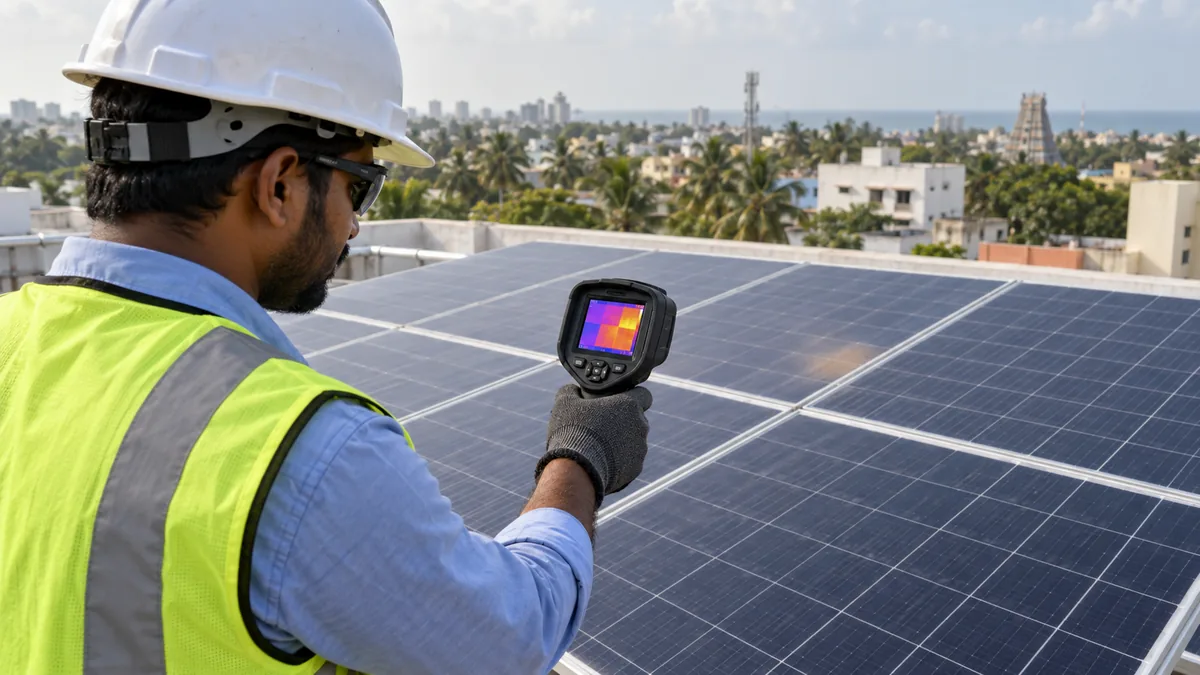
Chennai's heat, humidity, coastal exposure in some locations and severe weather make workmanship, material compatibility and enclosure protection important. Visual inspection alone cannot identify every problem. Thermal imaging, electroluminescence testing or electrical measurements may be needed depending on the symptom.
How to Tell Normal Variation from a Real Efficiency Problem
Use a consistent comparison rather than judging one day.
- Confirm that the monitoring system has complete data.
- Compare the current period with the same month or season from a previous year.
- Consider rainfall, cloud cover, temperature, grid outages and known shutdowns.
- Record recent changes such as construction, trees, roof equipment or cleaning.
- Compare strings or inverters that experience similar conditions.
- Check whether the decline was gradual, sudden or isolated to one component.
- Escalate unexplained, persistent or safety-related changes to a qualified technician.
A useful basic measure is specific yield:
Specific yield = Energy generated in kWh divided by installed capacity in kWp
For example, compare monthly kWh per installed kWp with an equivalent period, not the raw kWh of differently sized systems. A reliable assessment may also normalise for the sunlight available at the site.
For a step-by-step diagnostic path, use the companion guide on why a solar system is not producing enough power.
What a Professional Performance Test May Include
The test scope should match the problem. It may include:
- Review of inverter logs, alarms and grid events
- Comparison of string current and voltage
- Irradiance and module-temperature measurement
- I-V curve tracing against expected characteristics
- Thermal imaging for hotspots and connection heating
- Insulation-resistance and protective-device checks
- Physical inspection of modules, structures, cables and connectors
- Verification of meter, monitoring and export-control data
A single handheld reading without weather and temperature context cannot establish long-term degradation.
How to Reduce Avoidable Solar Performance Loss
- Keep generation monitoring active and review trends regularly.
- Clean modules according to condition and manufacturer guidance.
- Prevent new objects or vegetation from shading the array.
- Maintain safe airflow around panels and inverters.
- Arrange qualified inspection after severe weather, roof work or recurring alarms.
- Use compatible equipment and approved replacement parts.
- Preserve commissioning data, module serial numbers, warranties and maintenance records.
- Choose an installer that provides a transparent design and after-sales process.
The Viryasys Technologies solar company in Chennai page outlines rooftop and EPC support for residential, commercial and industrial projects. Buyers selecting modules can also review how to choose a solar panel before comparing efficiency claims.
When Should You Consider a Warranty Claim?
Consider a documented assessment when measured module performance appears below the applicable warranty level after ordinary causes such as shade, soiling, inverter faults, wiring losses and data errors have been ruled out.
Prepare:
- Invoice and warranty documents
- Exact module brand, model and serial numbers
- Commissioning and baseline test data
- Generation and monitoring records
- Maintenance history and photographs
- Technician's measurements and test conditions
- Evidence that other system components are operating correctly
The manufacturer or supplier may specify an approved testing and claim process. Do not remove modules or alter labels before understanding those requirements.
Conclusion
Solar-panel performance changes for many reasons, and only some of them are permanent degradation. Heat, cloud, dirt, shade, grid conditions, inverter behaviour and incomplete monitoring can all reduce the energy shown on a particular day or bill.
The best response is to establish a reliable baseline, compare equivalent periods, distinguish module behaviour from whole-system losses and investigate sudden or persistent changes safely. Good design, documented maintenance and early fault detection cannot stop natural ageing, but they can protect the usable output and life of the solar investment.