
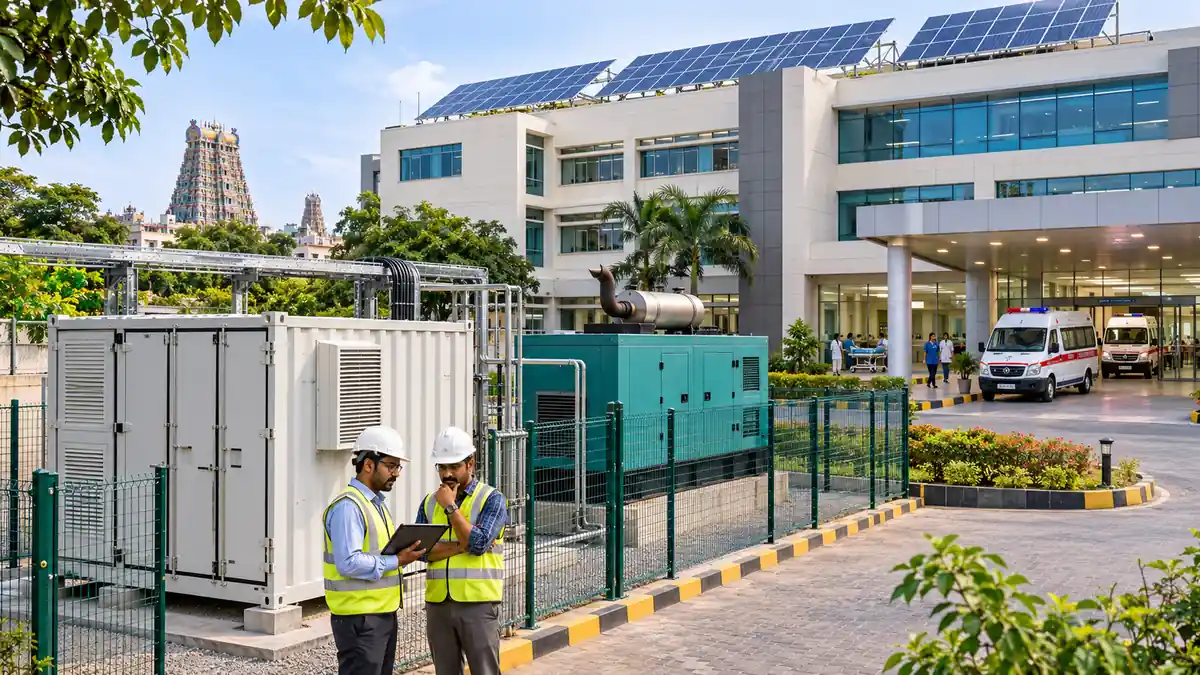
Hospitals are energy-intensive buildings with a complex mix of 24-hour critical loads, daytime outpatient activity, cooling, lifts, diagnostics, sterilisation, kitchens, water systems and administrative areas. That makes solar valuable, but it also makes simplistic sizing risky.
Rooftop solar can reduce daytime grid consumption. It does not automatically provide outage backup, and it should never be assumed to power every clinical load. A hospital project needs separate designs for energy savings, power quality and continuity of service.
Viryasys Technologies supports healthcare energy assessments through its solar company in Madurai, backed by solar EPC capability in Chennai and battery-storage engineering.
How Should a Madurai Hospital Size Solar?
Size the rooftop solar plant from the hospital’s dependable daytime electricity demand, usable roof, electrical approval limits and expected self-consumption. Then evaluate backup separately by identifying critical loads, their maximum simultaneous kW and the required duration.
Hospitals should not size a battery from monthly units or solar capacity alone. The BESS must be matched to the critical bus, UPS behaviour, generator sequence, medical-equipment requirements, state-of-charge reserve and safe operating architecture.
Start by Dividing the Hospital Load
Tier 1: Life-safety and continuity-critical loads
Depending on the facility, this may include selected ICU and NICU equipment, emergency-area equipment, OT support loads, medical-gas systems, blood-bank or pharmacy refrigeration, critical IT, nurse-call systems, essential lighting and designated ventilation. Clinical and electrical teams must approve the final list.
Tier 2: Important operational loads
These may include laboratories, dialysis support, selected lifts, water pumps, communications, billing systems and limited HVAC serving critical zones. Some can tolerate a short transfer; others cannot.
Tier 3: Deferrable or non-critical loads
General comfort cooling, laundry, electric heating, kitchens, non-essential lifts, large sterilisation cycles and some imaging loads may be scheduled or shed during constrained operation.
The exact classification varies by hospital. Do not copy another facility’s critical-load list without biomedical, clinical, fire-safety and electrical review.
Why HVAC Can Dominate the Solar Decision
Madurai’s cooling demand can be high during the same daytime hours in which solar generates. This alignment can improve self-consumption. However, hospital HVAC is not a single load: critical areas may require strict ventilation and temperature control, while offices and public spaces may be more flexible.
Collect chiller, VRV/VRF, AHU, split-unit and ventilation data separately. Record starting current, cycling, seasonal operation and whether equipment is served through essential or non-essential panels. Energy-efficiency measures, set-point optimisation, filter maintenance, variable-speed drives and controls can reduce the solar and storage capacity required.
ICU, OT and Diagnostic Equipment Need Special Treatment
Medical loads can be sensitive to voltage variation, harmonics, transfer time and electromagnetic compatibility. The project engineer should coordinate with equipment manufacturers and the hospital’s biomedical team.
- Do not assume MRI, CT, X-ray or sterilisation equipment can be placed on a general BESS-backed bus.
- Confirm UPS compatibility and earthing requirements.
- Separate continuous power needs from equipment with high short-duration peaks.
- Verify whether HVAC supporting an ICU, OT or imaging room is itself critical.
- Preserve isolation, redundancy and maintenance bypass arrangements.
Solar’s role may be to offset the facility’s aggregate daytime consumption while the existing UPS and DG architecture continues to protect critical clinical loads.
How Solar, UPS, DG and BESS Can Work Together
Rooftop solar
Generates variable daytime power and reduces grid import when the hospital is consuming it. Standard grid-tied solar shuts down during a grid outage unless an approved grid-forming source and control system maintain a safe local network.
UPS
Provides rapid, conditioned power to defined loads, often for short duration or until another backup source is established. Existing UPS autonomy and battery health must be documented.
Diesel generator
Provides longer-duration backup but has start time, fuel, maintenance, emissions and minimum-loading considerations.
BESS
Can provide fast response, bridge DG start, carry selected loads, reduce generator runtime or support peak management. It requires a power conversion system, energy-management controls, protection, thermal management and safety systems.
The correct sequence is site-specific. A BESS may maintain the critical bus during the DG start interval, then allow the generator to take sustained load. Alternatively, it may carry selected loads for a defined duration. Review What Is a BESS and How Does It Work with Solar? before comparing equipment offers.
Hospital Solar Sizing Workflow
Step 1: Gather electrical data
Collect 12–24 months of bills, interval load data, transformer and DG details, UPS logs, outage records, single-line diagrams and expansion plans.
Step 2: Measure representative days
Study weekdays, weekends, different seasons and major clinical schedules. Monthly units cannot reveal short peaks or transfer events.
Step 3: Map the roof
Account for water tanks, AHUs, ducts, lift rooms, helipad restrictions where relevant, fire access, maintenance paths, shade and structural capacity.
Step 4: Simulate generation and self-consumption
Model hourly solar production against hospital demand. Hospitals often have a useful daytime base load, but roof constraints can limit capacity before demand does.
Step 5: Design critical-power architecture separately
Create a critical-load schedule, maximum simultaneous kW, starting or surge requirements and autonomy target. Test normal, outage, maintenance and fault modes.
BESS Calculation Example for a Critical Bus
Assume an illustrative critical bus averages 60 kW and the hospital requires two hours of battery autonomy before allowing for operating reserves.
Required usable energy = 60 kW × 2 hours = 120 kWh.
The nameplate energy must be higher after accounting for permitted depth of discharge, conversion losses, auxiliary consumption, ageing and reserve state of charge. BESS power may also need to exceed 60 kW to handle simultaneous peaks.
This is only a screening calculation. Hospital design requires load measurement, fault studies, protection coordination, UPS interaction and clinical approval. The more detailed factory solar+BESS sizing method explains the distinction between kW and kWh and can be adapted by qualified healthcare engineers.
Roof, Fire and Infection-Control Planning
Installation should not disrupt sterile or clinical areas. Plan crane access, drilling, dust control, work permits, shutdowns and emergency routes. Roof penetrations and drainage must be controlled.
Battery location requires a separate safety assessment covering access control, separation, fire detection, emergency isolation, ventilation or cooling, drainage, signage and emergency response. Equipment should not obstruct ambulance movement or hospital evacuation paths.
Cost and Financial Evaluation
Separate the project into energy-saving and resilience components.
Solar benefit = Self-consumed solar units × avoided applicable energy cost + any approved export value − solar O&M.
BESS value may include = Avoided DG fuel + quantified peak benefit + outage-cost reduction + other permitted value streams − battery losses, O&M and lifecycle cost.
Do not assign an arbitrary financial value to patient safety. The resilience case should document clinical and operational risk alongside financial metrics.
Compare quotations for complete scope: solar EPC, electrical upgrades, structural work, UPS/DG integration, BESS/PCS/EMS, fire safety, commissioning tests, training, monitoring and maintenance.
Phased Implementation Can Reduce Risk
- Energy and critical-load audit.
- Rooftop solar for daytime savings.
- Monitoring and power-quality baseline.
- Critical-bus rationalisation.
- BESS pilot or defined backup phase.
- Expansion after measured performance.
A phased approach can reduce design uncertainty and avoid placing oversized storage on an unmeasured load.
Hospital Buyer Checklist
- Clinical, biomedical, electrical and fire teams involved.
- Critical loads approved and labelled.
- Interval data and outage logs analysed.
- UPS and DG sequence documented.
- Solar savings separated from backup claims.
- Roof, drainage and access verified.
- Protection and power-quality studies scoped.
- BESS usable capacity and end-of-life guarantee defined.
- Emergency response and maintenance bypass planned.
- Commissioning includes transfer and failure-mode tests.
- Monitoring shows solar, grid, DG, UPS and BESS states.
Conclusion
Solar for a Madurai hospital should reduce energy cost without compromising clinical continuity. The safest planning method sizes rooftop solar to dependable daytime demand, then treats critical backup as a separate engineering problem involving UPS, DG, BESS, protection and approved load segregation.
Hospitals can share bills, single-line diagrams, UPS/DG logs and a preliminary critical-load list with the Viryasys solar team in Madurai for a structured feasibility assessment.