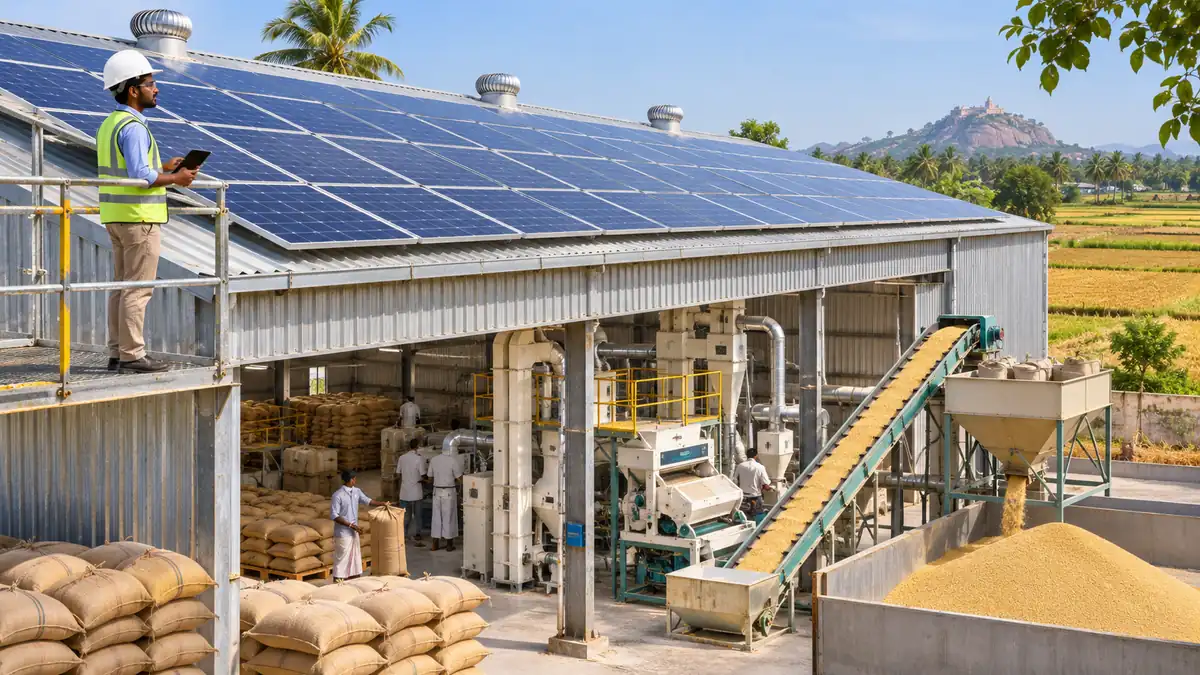
Rice mills can be strong candidates for rooftop solar because dehuskers, polishers, separators, blowers, elevators and conveyors often run during daylight. The catch is seasonality. A system sized only from the busiest milling month may export too much energy or remain underused during quieter months.
The right proposal begins with 12 months of electricity data, not a catalogue capacity. It should also account for motor starting, shift timings, dryer use, roof condition, dust, sanctioned load and future expansion.
Viryasys Technologies supports commercial and industrial feasibility through its solar company in Trichy team, with wider EPC support from its solar company in Chennai hub.
Is Rooftop Solar Worth It for a Rice Mill in Trichy?
Solar can reduce a rice mill’s daytime grid purchases when the array is sized to the mill’s annual and seasonal load profile. It is usually most valuable when milling equipment runs for several daylight hours and most solar generation is consumed on site.
It becomes less attractive when the system is sized to the roof instead of demand, when the mill is inactive for long periods, or when an old shed needs major structural work. The feasibility study should compare self-consumed units, exported units, capital cost, operating cost and expected plant availability rather than promise a fixed payback.
Why Rice-Mill Loads Need a Different Sizing Approach
Motor-heavy operation
Rice mills contain multiple induction motors that may start at different times but operate together. The site survey should record running kW, starting method, power factor, operating sequence and whether large loads cycle. Solar can offset real energy consumption, but it does not automatically solve every demand-charge or power-quality issue.
Seasonal throughput
Paddy availability, procurement, drying and milling schedules can create high-consumption months and low-consumption months. A three-month bill sample may show only one side of that pattern.
Day and night shifts
Solar output aligns best with daytime milling. A plant operating mainly at night may need a smaller grid-tied array or a separately justified storage strategy. Do not add BESS simply to make the solar number larger; compare battery losses, cycling value and capital cost first.
Dryers and parboiling
Where electrically driven dryers, pumps or parboiling systems operate, they may change the daytime base load significantly. Record whether these loads are seasonal, weather-dependent or run throughout the year.
The 12-Month Solar Sizing Method
Step 1: Collect complete electricity data
Gather 12 monthly bills, interval data if available, sanctioned load or contracted demand, maximum demand, power factor and tariff category. Add DG fuel and operating records if the mill uses backup generation.
Step 2: Build two load profiles
Create a milling-season profile and an off-season profile. For each, estimate the average load from sunrise to late afternoon and the hours for which it persists.
Step 3: Identify the dependable daytime base load
The dependable base is the load that regularly exists while solar generates. It may include elevators, separators, polishers, ventilation, lighting, offices and packaging. Intermittent peaks should not be treated as continuous consumption.
Step 4: Estimate generation conservatively
For early screening in Tamil Nadu, many designers use a broad annual yield range and then refine it through site-specific simulation. Orientation, tilt, shade, module temperature, dust, inverter losses, grid outages and maintenance all change the result.
Indicative annual solar generation = Proposed capacity in kW × modelled annual yield in kWh/kW.
Use the EPC proposal’s documented simulation rather than a universal promise.
Step 5: Limit excess during low-load months
Compare hourly solar production with off-season daytime demand. The best capacity is often the smaller of roof potential, approved electrical limit and economically useful self-consumption.
The detailed method in How to Calculate the Right Solar System Size can be adapted for a Trichy rice mill using industrial load data.
Worked Example: Why Annual Average Matters
Consider an illustrative mill that consumes 36,000 units per month during six active months and 10,000 units per month during six quieter months.
Annual consumption = (36,000 × 6) + (10,000 × 6) = 276,000 units.
Monthly annual average = 276,000 ÷ 12 = 23,000 units.
Sizing from the 36,000-unit peak alone could overstate the useful capacity. The next step is not simply to divide 23,000 by a generation factor; it is to check how much of those units occur during solar hours in both seasons.
If a proposed array generates more than the mill’s off-season daytime use, value the surplus under the applicable settlement arrangement—not at the avoided retail tariff. This distinction can materially change payback.
Roof and Site Checks for Rice Mills
Shed life and structural capacity
Solar modules may operate for decades. Installing them on corroded sheets or weak purlins can force expensive removal and reinstallation later. Assess sheet condition, purlin spacing, fasteners, wind loads, drainage and remaining roof life before design.
Rice dust and cleaning access
Husk and fine dust can accumulate on modules and equipment. Provide safe walkways, water or approved cleaning arrangements, inverter ventilation and a realistic cleaning schedule. Review the Viryasys solar panel maintenance guide for monitoring and inspection principles.
Fire and operational safety
Cable routing, isolators, earthing, lightning protection and emergency access should not obstruct material movement or fire paths. Coordinate lifting and installation with milling operations to avoid contamination and production hazards.
Shadow and rooftop equipment
Ventilators, chimneys, dryers and adjacent buildings can create moving shade. Layout software and on-site measurements should identify year-round losses.
What Determines Rice-Mill Solar Cost?
The final EPC cost depends on more than module wattage:
- System capacity and design voltage.
- Module and inverter specifications.
- Roof strengthening or sheet replacement.
- Mounting structure and corrosion protection.
- Cable routes and electrical-room distance.
- Transformer, panel and protection modifications.
- Metering and approval scope.
- Safety walkways, access and lifting.
- Monitoring, O&M and warranty scope.
- Shutdown constraints and project schedule.
Ask for a scope-normalised comparison. A lower quotation may exclude structural work, protection upgrades, approval support, monitoring or post-commissioning service.
How to Calculate Savings and Payback
Separate self-consumed energy from exported energy.
Annual benefit = (Self-consumed solar units × avoided unit cost) + (Exported units × applicable export value) − annual O&M and recurring charges.
Simple payback = Net project investment ÷ annual net benefit.
For a useful model:
- Use the latest 12-month bill, not only the highest tariff line.
- Include variable energy charges that solar can actually avoid.
- Do not assume solar removes all maximum-demand charges.
- Include degradation and realistic availability.
- Use the current approved export or settlement value.
- Test lower-generation and lower-self-consumption cases.
Commercial owners can also compare CAPEX with a solar power purchase agreement where available and contractually suitable.
Grid-Tied Solar or Solar with BESS?
A grid-tied plant is generally the starting point when the mill has strong daytime demand and a reliable grid. Standard grid-tied inverters shut down during an outage for anti-islanding safety.
BESS may be evaluated when the mill needs backup for defined critical loads, wants to reduce DG operation, has a recurring peak-shaving opportunity or has excess solar that can be shifted economically. Size the battery from the required kW and duration, not from solar capacity alone.
See What Is BESS and How Does It Work with Solar?
Questions to Ask a Solar EPC Company
- Did you analyse all 12 months of consumption?
- What percentage of generation is expected to be self-consumed in season and off-season?
- What yield, loss and degradation assumptions are documented?
- Has the shed roof been structurally assessed?
- Are dust, ventilation and safe cleaning access included?
- Which items are excluded from the EPC price?
- How will installation be phased around production?
- What data will the monitoring portal show?
- Who supports approvals, commissioning and warranty claims?
- What performance checks will be completed after handover?
Conclusion
Solar for a Trichy rice mill should be sized to the mill’s operating calendar, not the size of its roof or its busiest bill. Twelve months of electricity data, separate season and off-season load profiles, a structural survey and a transparent self-consumption model are the foundations of a reliable proposal.
To evaluate a project, share recent bills, operating shifts, major motor loads and a roof plan with the Viryasys solar team in Trichy. The result should be a capacity and financial model that can be audited, not a generic promise.