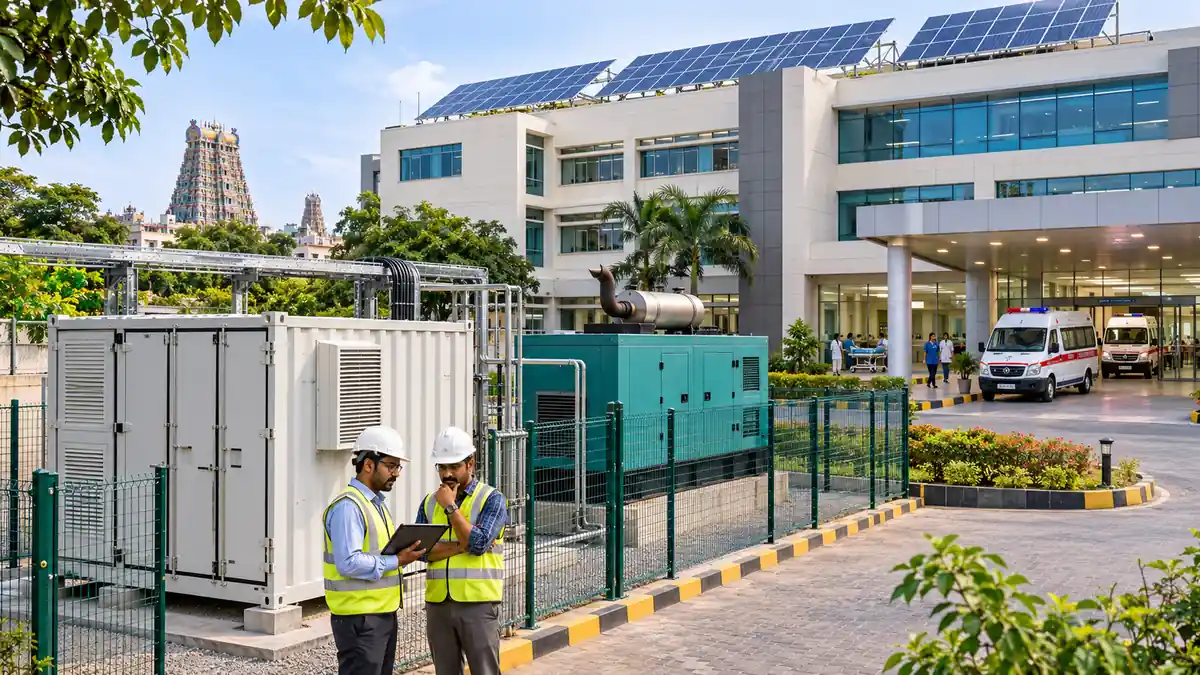
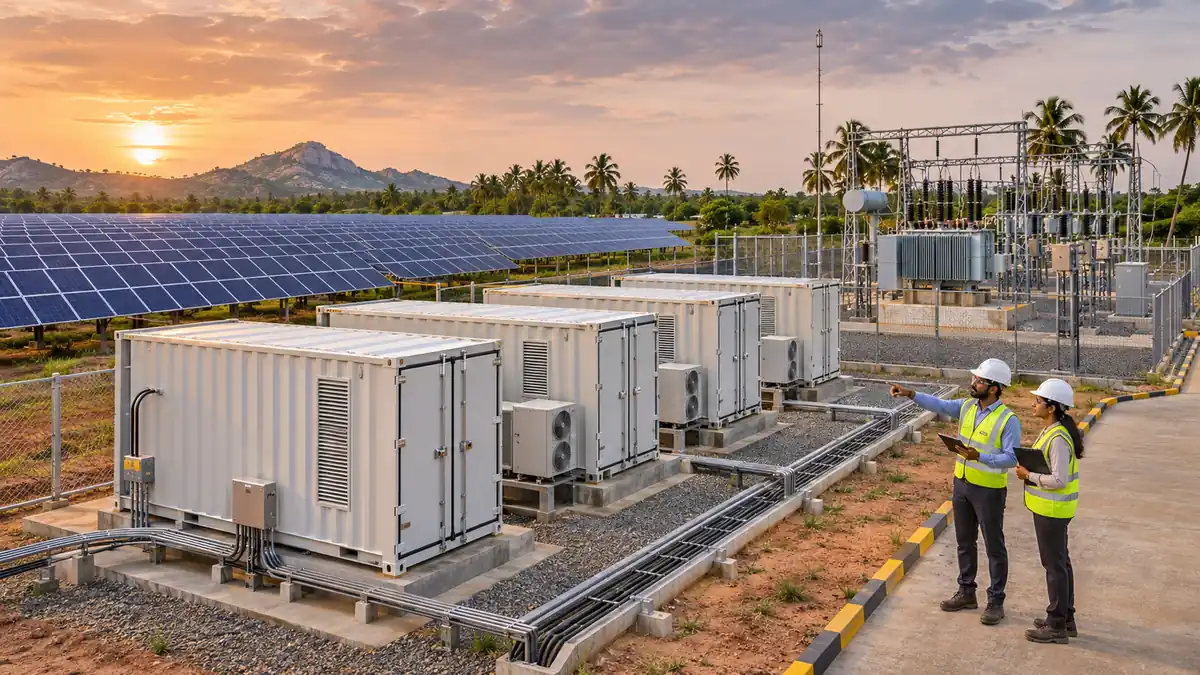
Tamil Nadu’s Battery Energy Storage Systems Policy, 2026 changes the planning baseline for certain new solar and solar-hybrid projects. For covered projects of 1 MW and above, battery storage is no longer only an optional add-on for peak shifting or backup. A minimum storage configuration is now part of the project requirement.
The headline sounds simple: at least 10% BESS power with four hours of discharge. The engineering decision is not. Developers must translate the rule into AC-side MW and MWh, confirm whether the project falls within the applicability window, integrate the battery at the approved point of connection and decide whether the minimum configuration is also commercially suitable.
For businesses evaluating solar-plus-storage, Viryasys Technologies can support feasibility and EPC planning through its solar company in Chennai team and battery energy storage systems expertise.
What Does the Tamil Nadu BESS Policy Require?
The Tamil Nadu BESS Policy 2026 states that new solar or solar-hybrid renewable-energy projects of 1 MW and above must install BESS with rated discharge power of at least 10% of the solar project’s installed capacity and enough usable energy for four hours of continuous discharge.
Both ratings are specified on the AC side. Therefore:
- A 1 MW solar project requires at least 0.1 MW / 0.4 MWh of BESS.
- A 10 MW solar project requires at least 1 MW / 4 MWh of BESS.
- A 100 MW solar project requires at least 10 MW / 40 MWh of BESS.
The rule applies to covered projects applied for on or after the policy notification date or commissioned on or after 1 April 2027. The notified policy should be checked against the project’s exact application, approval and commissioning history before procurement.
Tamil Nadu BESS Policy at a Glance
- Covered technology: New solar and solar-hybrid renewable-energy projects.
- Capacity threshold: 1 MW and above.
- Minimum BESS power: 10% of installed solar capacity, measured on the AC side.
- Minimum duration: Four continuous discharge hours.
- Minimum energy: BESS power multiplied by four hours.
- Applicability trigger: New applications after notification or commissioning on or after 1 April 2027, subject to the notified wording.
- Existing projects: Encouraged to add BESS, but should be assessed separately from the mandatory rule.
- Project responsibility: Battery replacement during the project life remains the developer’s responsibility.
This is a project-screening summary, not a substitute for a project-specific legal, regulatory or grid-connectivity review.
How to Calculate the Minimum BESS Rating
Start with the solar project’s installed AC capacity.
Minimum BESS power (MW) = Solar project capacity (MW AC) × 10%
Minimum usable BESS energy (MWh) = Minimum BESS power (MW) × 4 hours
Example for a 5 MW solar project
Minimum BESS power = 5 MW × 10% = 0.5 MW
Minimum usable energy = 0.5 MW × 4 hours = 2 MWh
The minimum configuration is therefore 0.5 MW / 2 MWh on the AC side.
The battery’s nameplate energy may need to be higher than the required usable energy. Depth-of-discharge limits, auxiliary consumption, temperature, degradation, conversion losses and end-of-life capacity must be considered. A proposal that simply labels a battery “2 MWh” without defining usable AC energy, operating window and end-of-life guarantee may not demonstrate compliance.
Does the Minimum Policy Size Equal the Best Commercial Size?
Not always. The policy establishes a floor for covered projects; it does not automatically optimise the storage system for every revenue or savings objective.
A project may require more BESS power if it must control a sharp injection ramp, shave a larger demand peak or support a high critical load. It may require more energy if the intended discharge window is longer than four hours, if the battery must retain the required output near end of life, or if solar shifting extends well into the evening.
Before final sizing, define the primary operating objective:
- Policy compliance
- Solar-energy shifting
- Peak-demand management
- Renewable firming
- Grid-support services
- Backup for selected loads
- Curtailment reduction
One battery can serve multiple objectives, but the energy-management logic must prioritise them. A battery reserved for backup cannot simultaneously be assumed to be fully available for daily peak shaving.
For a practical explanation of these trade-offs, see What Is a Battery Energy Storage System?
Which Projects Need Particular Attention?
New utility-scale and open-access solar projects
Projects being developed to supply commercial and industrial consumers should include storage in the concept design, land plan, single-line diagram, connection study, financial model and delivery schedule. Treating BESS as a late variation can alter auxiliary load, transformer rating, protection settings, evacuation design and capital requirements.
Businesses considering remote supply can also review the Viryasys guide to ground-mounted open-access solar serving Chennai.
Solar-hybrid projects
The system controller must coordinate solar generation, charging, discharge and grid instructions. The project should define whether charging will come only from solar or may also use the grid, subject to applicable rules and contracts.
Projects near the 1 MW threshold
Do not split or resize a genuine project merely to avoid a threshold. Determine the capacity that serves the load and commercial objective, then evaluate the rule, connection category and long-term expansion plan accurately.
Projects already in development
Application dates, approval status, procurement stage and expected commissioning date matter. Obtain a written regulatory interpretation where applicability is uncertain; a schedule slipping beyond 1 April 2027 may change the analysis.
Technical Design Checks Beyond MW and MWh
Point of interconnection
Confirm whether solar and BESS connect behind a common meter, share an evacuation system or use separate connections. The single-line diagram must show power flow, metering, isolation and protection.
PCS and transformer rating
The power conversion system must deliver the required AC discharge power under expected site conditions. Transformer and cable ratings should cover operating modes without assuming that solar and BESS can never coincide unless controls enforce that limit.
Usable capacity and degradation
Specify beginning-of-life and end-of-life usable capacity, permitted depth of discharge, round-trip efficiency, cycle limits and augmentation or replacement strategy. The developer is responsible for maintaining the required capability through the project life.
Safety and emergency response
Site planning should include separation distances, fire detection and suppression strategy, ventilation or thermal management, emergency isolation, drainage, access and an incident-response plan. Applicable CEA safety requirements, electrical standards, fire requirements and battery-waste rules must be reviewed by qualified professionals.
EMS and operating logic
The energy-management system should define charging priority, state-of-charge reserve, dispatch windows, grid commands, export limitation and fault response. Include cybersecurity, remote monitoring and event logging in the specification.
Commercial Questions to Model Before Investment
The policy minimum creates a capital obligation, but the commercial value depends on operation. Model at least three cases:
- Compliance-only case: Minimum BESS operated within the project requirement.
- Optimised case: Storage scheduled for solar shifting or another measurable value stream.
- Stress case: Lower-than-expected utilisation, degradation, replacement cost and commissioning delay.
The model should separate:
- Solar EPC cost
- BESS cells, racks or containers
- PCS, transformer and switchgear
- EMS, SCADA and communication
- Civil works and safety systems
- Auxiliary consumption
- Annual O&M and insurance
- Augmentation or replacement
- Financing cost and taxes
- Connection, approval and testing costs
Avoid counting the same stored unit twice, for example, once as avoided curtailment and again as a full peak-tariff saving, unless the interval model proves both values can be realised.
Project-Planning Checklist
- Confirm the solar project’s AC capacity and category.
- Record the application, approval and target commissioning dates.
- Calculate the policy-minimum BESS power and usable energy.
- Define the commercial operating objective separately.
- Collect solar profile, load profile and grid-constraint data.
- Prepare an integrated single-line diagram and protection philosophy.
- Define usable capacity at beginning and end of life.
- Specify PCS, EMS, transformer and auxiliary systems.
- Complete fire, electrical and environmental safety reviews.
- Model augmentation and battery replacement responsibility.
- Confirm land, access, drainage and emergency clearances.
- Validate the latest SNA, TNPDCL, TNERC and statutory process before ordering equipment.
How Viryasys Technologies Can Support Solar-Plus-Storage Projects
Viryasys Technologies approaches storage as an integrated power-system decision. The work begins with the project objective and data, followed by solar/BESS sizing, electrical design, equipment selection, protection, control philosophy, construction planning, commissioning and performance monitoring.
Developers and industrial consumers can consult the Viryasys solar EPC team in Chennai to evaluate policy applicability and build a technically coherent project brief before requesting equipment quotations.
Conclusion
Tamil Nadu’s BESS Policy 2026 makes storage a mandatory design input for covered new solar and solar-hybrid projects of 1 MW and above. The minimum is 10% discharge power for four hours, measured on the AC side, but compliance is only the starting point.
A bankable project must also define usable energy, degradation, control logic, safety, connection design and the commercial purpose of every battery cycle. Confirm applicability early, because adding BESS after the solar project is substantially designed can create avoidable redesign and schedule risk.